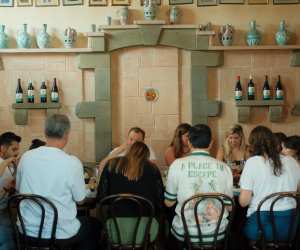
I have interviewed celebrity chef Nobu Matsuhisa twice in my career. The first time, he cried. The second, he laughed. On both occasions, I intermittently held my breath. Not because I was within feet of the man who gave sablefish the glow-up of a lifetime (see: black cod), but because, in another life, I participated in something legally… complicated at his Mayfair restaurant. An interaction that would begin with me stepping into Nobu Park Lane under a false name and leaving with a manila envelope thick with £50 notes.
For housekeeping purposes, here I must state that this had nothing to do with the honourable Mr Matsuhisa, nor the Oscar-winning Mr De Niro, or any of their staff, for that matter. At least, not directly. This was a negotiation between me, my alter ego, and a very different businessman who’d flown in from an undisclosed location in Japan.
The year was 2015 – around the same time Future’s words “Nobu, Nobu, Nobu,” boomed into the public consciousness on Drake’s track ‘Jumpman’ – and I was a young, reckless student skipping class in favour of unpaid internships at glossy women’s magazines. Back then, before Substack, ChatGPT and ‘the algorithm’, unpaid work was one of the few ways to secure a job as a writer, and likely one of the main reasons why, besides nepotism, 54% of UK journalists had attended private school, despite only 7% of the population having done so. Today, that number has dropped to 33%, though for those without generational wealth to fall back on, it can still prove a prohibitive experience.
Matilda Hill-Jenkins

Matilda Hill-Jenkins
Despite my parents working incredibly hard, like most people from working-class backgrounds, I didn’t have the financial cushioning to work for free in The Big City. And so, for a long time, I worked seven days a week: weekdays I made tea, compiled research and fannied around with press releases with the glee of a groupie who couldn’t believe they were allowed to pop the kettle on; weekends I flattered middle-aged men into merino jumpers and crammed in just enough studying to pretend I was still a student. It wasn’t difficult, as such, but it did eventually become exhausting in the way that zaps the joy out of everything besides eating, sleeping and getting blackout drunk.
My circumstances changed when a friend in a similar situation introduced me to an app she’d been using to keep on top of her credit card debt. “You just go out for dinner with men and they give you money,” she shrugged. When it loaded, clunkily, on my prehistoric iPhone, it advertised fast money and free time in exchange for my “companionship”.
I didn’t have to squint to read between the lines. Where many people saw the unthinkable, I saw an opportunity to eliminate a barrier erected by this country’s class system. And so, soon enough, I found myself drawn into the taboo. The unknown. The cavernous, all-encompassing world of sex work. In the grand scheme of things, my role was fairly vanilla. I was the professional girlfriend. A beau for hire, employed to foster mid to long-term connections with men who craved the intimacy of a committed relationship without the follow-up questions. A situationship, if you will.
Where many people saw the unthinkable, I saw an opportunity to eliminate a barrier erected by this country’s class system
In return, I would receive a monthly salary, enough to allow me to quit my shop job and focus on edging my way onto the media landscape that I continued to eye with naive, unadulterated optimism. At the time, this felt like agency. A choice. And in many ways, it was. I could have worked two regular jobs, even three, like many people do. But I’d found a gap in the fence, a faster, less exhausting way into the industry that rolls out the red carpet for the sons and daughters of politicians, publishing moguls, socialites and certain school alumni. Once inside, all I had to do was convince the guards to let me stay.
The truth is, though, for me and the other female writers I know who inevitably found themselves in the very same situation, to succeed – or, god forbid, thrive – in an industry shaped by wealth and nepotism, our illusion of choice is hindered by the threat of debt and the reality of unpaid labour.
I won’t dredge up the nitty-gritty details of The Job, but, in hindsight, I can confirm it was a challenging, bizarre and often incredibly dangerous experience. One which I may never truly recover from. At its core, this type of work requires you not just to minimise the human aspects of yourself, but adopt and sustain someone else’s perception of you entirely. And when you’re little more than a reflection of a person’s fantasy or desire, there’s no room for human error, despite its inevitability. Still, I was in a much more privileged position than many other sex workers, who are forced to accept far worse working conditions for far less money, sometimes with no autonomy or freedom at all.
My specific niche even had its perks. If you’ve ever set foot in Chelsea or Mayfair, you’ll likely suspect that much of this line of work – interviews, negotiations, and the relationship itself – plays out in public. And you’d be right. As a result, it was an experience that demanded that I hone a certain amount of emotional intelligence and an acute awareness of space. It was also an experience that, I would later realise, served as my introduction to the world of bars and restaurants in a way that still serves me today. I saw just how strange and brilliant and wild restaurants and bars can be when a guest is uninhibited by something as disposable as money.

Matilda Hill-Jenkins
That’s not to say I didn’t experience hunger to explore the city’s food and drink scene before my first jittery, wide-eyed lunch with an entrepreneur who arrived via private plane. Here in London, you can do quite a lot with very little. I’d already devoured student-friendly dishes at Street Feast, meatballs at Polpo, and two-for-one cocktails at Be At One. And so, like any person who enters these spaces, I’d come to know them as hubs of discovery, comfort, romance, joy, desire, connection, and even disappointment. I also knew that for anyone who can afford the price of admission, pubs, bars and dining rooms are neutral territory, places where strangers, lovers, friends and foes can meet and at least attempt to reenact the fantasy that they arrived with.
What this unorthodox side-hustle did was prepare me for the career I have now: where dinner is the job. Except back then, my brief was to please, not to participate, and it was that differentiation which allowed me the space to observe from a very different position than the one I occupy now. Today, I’m fortunate that my opinions on food, drink and hospitality shape my work and even help to secure commissions. But when you’re little more than an ornament, you have the space to allow your beliefs and preferences to flicker, change and grow from a distance.
The uninitiated might imagine this kind of work unfolding in glitzy, gaudy playgrounds like Bacchanalia or Sexy Fish, and much of it does. But more often, it thrives in the everyday, camouflaging itself in the ordinary. Everything from grand dining rooms and subterranean speakeasies to casual wine bars and cosy neighbourhood cafés is uniquely suited to these interactions because each can legitimise intimacy without explanation. Whether the toilets have Aesop handwash or luminescent green paint-stripper, they’re among the few semi-public spaces where money, closeness and prolonged attention can coexist without raising suspicion. And so, on the surface, much of my experience at restaurants, bars and private members’ clubs was no different to that of any other visitor. My fee covered the cosplay that indulged the paying party’s fantasy of enjoying a normal ritual in a regular relationship, just without any mention of whose turn it is to take the bins out.
Nevertheless, as I swapped one patron out for another, I came to understand that restaurants, bars and members’ clubs enable this kind of sex work for another reason: they are some of the few spaces where indulgence is not just tolerated but celebrated. In everyday life, excess is suspicious. Spending too much, wanting too much, and enjoying too openly can be seen as vulgar, greedy, or morally suspect. But inside these spaces, those same behaviours are reframed as discernment, curiosity and culture. Good taste becomes a stand-in for virtue because we assume the person who possesses it is thoughtful, or even… ethical.
From my seat at the table, I found that restaurants and bars allowed the men I worked with to feel safe, protected and respectable, while legitimising their more socially unpalatable desires
This is where I found a more unsettling aspect to come to terms with. After a while, it’s difficult to escape the sense that, for a certain section of society, hospitality spaces are employed as a tool to launder one’s moral conscience. Respectable, accessible, lovable places which operate in plain sight are used to soften the reality that a transaction is taking place. Much like Donald Trump and Elon Musk having dinner at Mar-a-Lago while former Venezuelan president Nicolás Maduro was being transported in his tracksuit to New York City, the presence of sustenance allows those involved to pretend that what’s going on is just dinner.
From my seat at the table, I found that restaurants and bars allowed the men I worked with to feel safe, protected and respectable, while legitimising their more socially unpalatable desires. Be it an age gap or the unspoken reality that the person paying is employing a mistress, such spaces allow anonymity and spectacle, etiquette and acquiescence to coexist. Here, the likelihood of a man being challenged about their life choices is next to none. Meanwhile, for me, the table might seem safe, but the risk remains, be it financial, physical or reputational.
Whether you view discretion as a must-have menu item or more of a precursor for plausible deniability, there is no question that wielding it and maintaining it is a tremendous skill. What I came to understand in my time providing the professional girlfriend experience is that it’s not free, at least not for those working the floor. To be discreet requires emotional labour. It asks waiters to maintain warmth while suppressing curiosity, to be alert without being reactive, and to prioritise comfort even when it isn’t evenly distributed before them. They’re required to carry moments of tension they didn’t create, and to resolve them without ever acknowledging they exist, all while carrying piping hot plates. I recognised the choreography because I’d performed it myself: the feminised, poorly paid labour of managing male ego, deflecting awkwardness and keeping the atmosphere buoyant at any cost. Besides giving up this work and becoming a waitress, this is how I know it’s so important to treat those in service roles with the utmost respect: those uncomfortable moments don’t disappear when the table is cleared; they’re wrapped up in a tinfoil swan and carried home by someone else.
In this culture, sex and sex work are drenched in shame, be it our own or that dumped on us by other people. So, back then, when the pretence of privacy was sometimes shattered by, say, an ex-wife’s friend sitting at a nearby table, it was hard to ignore what happened next. Because, whether I liked it, agreed with it, or not, I discovered that a person’s choice of bar, restaurant or members’ club was a reflection of their shame – or lack thereof.

Matilda Hill-Jenkins
For those uninhibited, there were long, champagne-fuelled lunches outside Scott’s or lobster on the Royal Opera House balcony on full display. And for those steeped in it either from the outset or after a shock to the system, there were cocktails sipped in the darkness above Milk & Honey, som tam salads eaten behind Venetian blinds near Crewe Train Station, and country pubs miles (and miles) away.
Of course, the venue wasn’t just about who might see us. It was also about what I was supposed to be. Some men were deeply invested in the idea that I was a girlfriend – a wide-eyed, barely twenty-something woman vying for their affection – rather than a temporary employee. To them, the distinction mattered because sex work, like most things, exists within its own hierarchy. Certain roles are granted a veneer of romance or discretion; others are treated as more overtly transactional. By framing me as a ‘girlfriend’, they could situate us both nearer the ‘respectable’ end of that spectrum, and the setting was leveraged to reinforce it. A bright, sunny, bustling dining room suggested romance; a dimly lit members’ club suggested something else.
Either way, I was somewhat happy. Partly, because none of this was my shame, but mostly because I’d much rather be drinking Thai iced tea.
To be discreet requires emotional labour
Though there were times when that same uncomfortable feeling was thrust upon me. Not necessarily because of the work I was doing, but because in this scenario, there is no illusion that we live in an equal society. It’s very clear who makes the rules and who shapes society’s understanding of taste. With one client, requesting I dress up like a schoolgirl was fine, but eating popcorn was ‘common’.
I’m sure most restaurateurs would shudder at the thought of all this being attached to their restaurant, and I don’t blame them. But like birthdays, marriage proposals, and break-ups, sex work has been a part of life since before 2300 BCE. That’s 4,064 years before the first formal restaurant was established in 1765, and around 4,304 years before me.
I know that revealing myself here, be it in pixels or on paper, puts me at risk of scrutiny and judgment. But the truth is, I’m not ashamed. If I didn’t take the risk and learn all of this, I wouldn’t be able to enjoy restaurants, bars, cafés, food markets, pubs and street food stalls in the way I do today. More than a decade ago, these places taught me about care, performance, society and survival. They revealed to me the power of hospitality and the anatomy of shame; that every plate costs someone something, and you rarely see who really pays.