Four recipes from Henry Harris' new cookbook The Racine Effect

Bouchon Racine is one of London’s hottest French restaurants. Head chef Henry Harris shares the best recipes in his cookbook, The Racine Effect

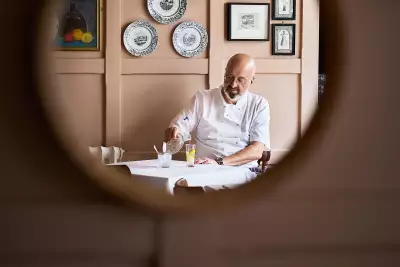
Henry Harris portrait

The French bistro revival in London has been widely observed and celebrated, but few restaurants capture its spirit quite like Bouchon Racine. A love letter to the bistros of Paris and Lyon, it embodies everything inviting and comforting about Gallic cuisine, with the warming, comforting aromas of classic garlic-licked snails and onion soup.

In his new book, The Racine Effect, Henry Harris charts his career through 120 iconic dishes, creating a work that is as much memoir as recipe book. It details a lifelong love affair with nostalgic French cooking. Bouchon Racine itself is a rebirth of Harris’s revered Racine, which closed in 2015. Since opening above The Three Compasses pub in 2022, it has become one of London’s most acclaimed restaurants, regularly classed as one of the best French restaurants in the capital, and ranking fifth at the National Restaurant Awards in 2025.

The recipes in this cookbook are timeless, deceptively simple, and make it hard not to feel a little romantic about the history of French cooking. A dash of care, patience and a focus on technique and quality ingredients will see you cooking up côte de boeuf, mustardy bistro salads and wine-soaked desserts.
Tomates farçies

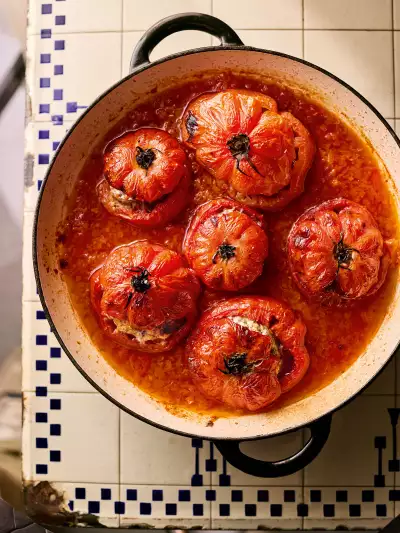
Plump tomatoes stuffed with a hearty filling of sausage, veal and herbs make for a juicy dish that more than earns its place as the centrepiece

Tomatoes Farçies

Serves 4

Preparation time 30 minutes

Cooking time 40 minutes

If tomato season wasn’t already marked up on your calendar, this recipe – complete with a delicious, herby filling of minced pork and veal – will have you counting down the days. While it’s for summer dinner parties, this is the type of umami bomb that you’ll want to cook, eat and serve all year round.

“There are two versions of tomates farçies: one in which rice and vegetables form the stuffing for the tomatoes and another that is stuffed with a combination of minced pork and veal with herbs and garlic,” says Harris. “Unsurprisingly, I prefer the latter option, as the meat juices combine with those from the tomatoes to form a wonderful savoury jus. The breadcrumbs help to retain a little of the cooking liquor and the cream adds a soft richness. These are at their best when served lukewarm on a sunny terrace, accompanied by a big salad and a chilled Provençal red.”

Ingredients

  • 4 large or 8 medium bull’s heart tomatoes (or similar), big enough for stuffing
  • 3 round shallots, finely chopped
  • 250 ml dry white wine
  • 250 g Toulouse sausage meat or coarsely minced pork
  • 250 g minced veal
  • 2 tablespoons chopped flat-leaf parsley leaves
  • ½ teaspoon chopped thyme leaves
  • ½ teaspoon chopped rosemary leaves
  • Zest of ½ lemon
  • Pinch of chilli flakes
  • 2 garlic cloves, finely chopped
  • 1 heaped tablespoon dried breadcrumbs
  • 2 tablespoons crème fraîche
  • Olive oil, for frying
  • Salt and freshly ground black pepper

Method

1. Preheat the oven to 170°C fan.

2. Cut the tops off the tomatoes and set them aside to use as ‘lids’ later. Carefully scoop out the pulp of the tomatoes, leaving the flesh layer attached to the skin. Keep the pulp.

3. Warm a splash of olive oil in a frying pan over a medium heat, then gently fry the shallots for 5 minutes, or until translucent and soft. Add the reserved tomato pulp and cook for a further 5 minutes.

4. Add the white wine, bring to a simmer and cook for 2 minutes. Season with salt and pepper, then transfer to a roasting tin.

5. Put the sausage meat and veal into a bowl along with the herbs, lemon zest, chilli, garlic, breadcrumbs and crème fraîche. Season with salt and pepper. Taste for seasoning.

6. Season the inside of the scooped-out tomatoes, then stuff them with the meat mixture, filling them to the brim. Place the lids back on top. Put them in the roasting tin with the white wine mixture. Cover tightly with foil and then cook in the oven for 30 minutes.

7. After 30 minutes, remove the foil and increase the oven temperature until you reach 180°C with fan.

8.Cook for a further 10 minutes. If the wine looks as though it will evaporate completely, add a splash of water.

9. Remove the tomatoes from the oven and check that the meat is cooked through. The internal temperature should reach at least 72°C (162°F) when tested with a probe thermometer. Transfer to plates and serve with the pan juices spooned over the top or leave to rest and cool, and then serve warmish.

Côte de boeuf et sauce béarnaise

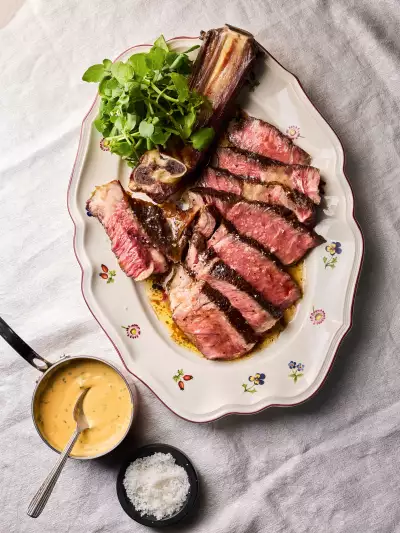
Perfectly pink rib-eye steak with béarnaise is a bistro classic for a reason. Master this icon and become the host with the most

Cote de boeuf

Serves 4

Preparation time 35 minutes

Cooking time 35 minutes

Steak and béarnaise is one of those magic-trick recipes that every home cook desperately wants in their repertoire.

“Côte de boeuf is one of my favourite pieces of meat to cook,” says Harris. “The beef must also be allowed to come to room temperature so that when you start the cooking process, the heat source doesn’t have to work so hard to penetrate the cut. The heavy marbling of ribs means that as the meat cooks, the intramuscular fat softens like a liquid jelly, giving the meat the most remarkable succulence.”

Ingredients

  • 2 x 700–900 g côte de boeuf (bone-in rib-eye steaks) at room temperature
  • 125 g unsalted butter
  • Olive oil, for drizzling
  • Salt and freshly ground black pepper
  • 2 bunches of watercress, to serve
  • 1 bunch of fresh tarragon, leaves and stalks separated
  • 50 ml white wine vinegar
  • 2 round shallots, chopped
  • 6 peppercorns
  • 1 bay leaf
  • 4 medium egg yolks
  • 250 g unsalted butter

Method

1. Put the tarragon stalks into a small saucepan along with the vinegar, shallots, peppercorns, mace (if using) and bay leaf. Add a good splash of water, bring to the boil and then simmer until half the liquid has evaporated.

2. Prepare a barbecue with glowing embers. If you are using a kettle-type barbecue, then bank the coals on one side so you can move the meat to the side if needed to avoid burning it or creating too many flames.

3. Season the beef very well. Heat a heavy frying pan over a high heat and add a good splash of oil. Add the steaks and brown until a good crust is starting to develop, then flip them over and do the same again. Repeat this step several times, turning every 2–3 minutes and reducing the heat a little once a crust starts to form, until they have a wonderful browned exterior.

4. Once well browned, remove the pan from the heat and add the butter. It will melt and foam promptly. Using a spoon, baste the two ribs repeatedly.

5. Place the pan back over the heat, reduce the heat and continue to cook the ribs for a further 8–10 minutes. Turn the steaks occasionally and take care not to burn the butter.

6. A probe thermometer can remove any uncertainty: 45°C core temperature for rare and 50–53°C for medium-rare.

7. Remove the steaks from the pan and transfer to a serving platter, then spoon over the pan juices and leave to rest in a warm place for 15–20 minutes.

8. While the meat rests, make béarnaise. Place a heatproof bowl over a pan of boiled water. Add the yolks and vinegar reduction and whisk for 2 minutes until the mixture is a light, pale cream.

9. Meanwhile, melt the butter until piping hot. Pour the butter into the egg yolk mixture drop by drop, increasing the pouring speed once the mixture has emulsified and started to thicken.

10. Keep a kettle of hot water to hand and, should the mixture become too thick or look as if it is about to split, add a splash.

11. Once all the butter has been added and the sauce is completely emulsified, chop the tarragon leaves and stir them into the sauce along with salt and pepper.

12. To serve, slice each rib into six or eight pieces and divide them equally between plates, then garnish with a handful of watercress. The béarnaise is best placed in a bowl on the table.

Salade Lyonnaise

Who said salads can’t be filling? Laden with buttered croutons, thick-cut bacon and a jammy poached egg, salade Lyonnaise hits the spot

Salad Lyonnaise

Serves 4

Preparation time 20 minutes

Cooking time 10 minutes

Underestimate the power of a great salad at your peril – Harris certainly doesn’t. The star of the show here is a zingy, glossy mustard dressing that clings luxuriously to the leaves and brings it all together. Its deliciousness is only matched by the deceptive ease with which this salad can be prepared; it’s a French bistro staple for good reason.

“There are certain salads that are always a satisfying pleasure – Greek salad and Caesar salad are such examples – and a salade Lyonnaise is in that club,” says Harris. “When selecting the frisée, choose the one with the biggest heart of pale yellow leaves, as they are the most tender and have a pleasing bitterness compared to the dark outer leaves, which can be too strong. Buy an unsliced piece of bacon, too, as that will provide you with more meaningful cubes when diced – wispy strands of sliced bacon just aren’t the same. The lardons should be a similar size to the sourdough croutons.”

Ingredients

  • 1 frisée
  • 2 tablespoons chopped shallot
  • 4 small slices of sourdough bread, made into buttered sourdough croutons
  • Splash of vegetable oil
  • 250 g unsmoked thick-cut bacon, cut into large lardons
  • 4 very fresh medium eggs
  • 2 tablespoons water

For the mustard dressing

  • 8 tablespoons Dijon mustard
  • Generous pinch of salt
  • 75 ml red wine vinegar
  • 75 ml water
  • 400 ml vegetable oil

Method

1. Prepare the frisée by first separating the leaves and discarding the very dark ones, then washing and drying them.

2. Place the leaves in a salad bowl and add the shallot and croutons.

3. Heat the oil in a frying pan over a medium heat and fry the lardons for 3–5 minutes until they brown but do not become crispy or crunchy.

4. While the bacon is cooking, bring a shallow, wide pan of well-salted water to a gentle simmer to poach the eggs.

5. Time is not on your side at this point, but focus will bring success. Crack each egg and gently slip them into the water, then poach them for about 3 minutes, or until the white is set and the yolk is warm and runny.

6. The moment the eggs are in the water, remove the bacon pan from the heat and pour out the excess rendered fat, then add the mustard dressing and water to the pan and use a spoon or spatula to work everything together. Scrape this out over the frisée salad, toss it together and divide between plates.

7. Use a slotted spoon to lift each egg from the pan and place one on top of each salad. Serve immediately.

Mustard dressing

8. Put the mustard, salt, vinegar and water into a food processor and blend for 30 seconds. Now gradually pour in the vegetable oil in a steady stream while blending until emulsified.

9. Scrape the dressing into a bowl and store until it is needed. As there are no fresh ingredients it keeps for a couple of weeks, after which it will start to lose its punch and astringency.

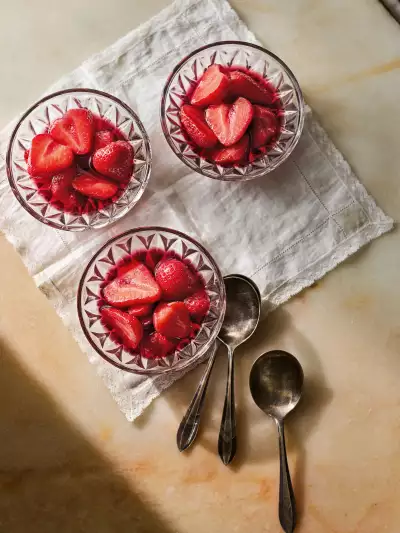
Strawberries in beaujolais

The best of summer strawberries, gently macerated in sugar, orange liqueur and bright, fruity beaujolais, make a dessert that feels effortlessly elegant. Simple to assemble and utterly dependent on good ingredients

Strawberries in Beaujolais

Serves 4

Preparation time 10 minutes

A true British summertime classic with a French twist, this dessert could be Bouchon Racine’s mission statement on a plate. Great year-round, but come April, as the strawberries slide right into season, it delivers a dessert that feels decadent but achievable for the home cook.

“Another old favourite that I learnt when working at Hilaire with Simon Hopkinson,” recounts Harris. “When the first good Gariguette strawberries arrive from France in April/May, this is the recipe I turn to. What is key is that the strawberries have a deep, sweet, jammy flavour. The beaujolais must be bright and fruity.”

Ingredients

  • 350 ml beaujolais
  • 2 tablespoons caster sugar
  • Splash of orange liqueur
  • 600 g strawberries

Method

1. Whisk the wine and sugar together in a bowl until the sugar has dissolved. Add a splash of orange liqueur.

2. Hull the strawberries and halve and then macerate them in the sweetened beaujolais an hour before you want to serve them. After a couple of hours, they start to break down and the pleasure of this dish is lost.

3. To serve, divide the strawberries between all of the bowls and pour the wine over them.

Loading