Turkey, a blazing Christmas Pudding, The Muppet Christmas Carol. Whoever you are, and however you do or don’t celebrate, the chances are that at some point during the month of December you will enjoy (or endure) one of, if not all, of these. Yet while it does not take my bachelor’s degree in English literature to work out that The Muppet Christmas Carol was inspired by Dickens’ A Christmas Carol, published in 1843, some readers might be surprised to learn that Mrs Cratchit was as defining in shaping Christmas Dinner as she was to Miss Piggy’s iconic performance.
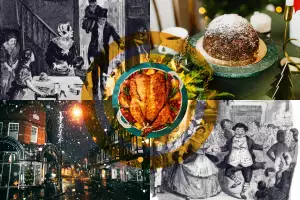
Those who are more familiar with the novel than the puppeteer’s reincarnation may remember the scene: Mrs Cratchit unveiling the steamed pudding amidst a “great deal of steam” and “a smell like an eatinghouse and a pastry cook’s next door to each other, with a laundress’s next door to that!” Mrs Cratchit re-entering the dining room, “flushed, but smiling proudly; with the pudding, like a speckled cannon-ball, so hard and firm, blazing in half of half-a-quarter of ignited brandy, and bedight with Christmas holly stuck into the top.”
So nuanced and literary and laden with anticipation is the description, it would be iconic even if it hadn’t had the culinary influence which many food historians claim it has. Yet the legacy of this scene doesn’t stop there, with the young Cratchits’ delight and Bob Cratchit declaring it was “the greatest success achieved by Mrs Cratchit since their marriage”; it is smelt, seen and tasted with every Christmas pudding that is steamed, set alight and devoured today.
It is the reason we still eat plum pudding, when so many medieval foods have since fallen from favour; and it is the reason we eat it at Christmas, and that ‘Christmas’, rather than ‘plum’, has become its moniker. “Until the publication of A Christmas Carol, Christmas pudding was known only as plum pudding – but after that, plum pudding was afterwards always referred to as Christmas pudding,” says Pen Vogler, food historian and author of Scoff: A History of Food and Class in Britain and Christmas with Dickens.
Until the publication of A Christmas Carol, Christmas pudding was known only as plum pudding
It’s not that we didn’t eat it, or that we didn’t eat it on celebratory occasions; on the contrary, “plum puddings were a common companion to beef on festive days; they were eaten before or along with the meat,” writes fellow food historian Regula Ysewijn, author of the Official Downton Abbey Christmas Cookbook. We enjoyed it as one might apple sauce with pork, or mint jelly with lamb; as a slightly sweet accompaniment to a savoury meat course. “The first written record of a recipe for plum pudding as we know it today can be found in John Nott’s The Cooks and Confectioners Dictionary from 1723,” Ysewijn continues, but there is “no suggestion [there] that the pudding is associated with the practice of Stir-up Sunday, or the Christmas feast.”
Indeed, it is not until 1844, the year after A Christmas Carol comes out, that a recipe for Christmas pudding first appears officially: in Victorian food writer Eliza Acton’s seminal cookbook, Modern Cookery for Private Families. The recipe for this “remarkably light small rich pudding” (her words) boasts an extra glug of booze, an extra handful of raisins, and is indistinguishable from Christmas pudding recipes you’d find in this particular ‘modern’ age. Coincidence? Food historian and author Neil Buttery thinks not. “Eliza Acton was a great friend of Charles Dickens, and it cannot be a coincidence that Dickens writes this scene, featuring an extra special plum pudding, and that she then writes a recipe for it. From a gastronomic point of view, it’s just an extra glug of brandy and more raisins; but from a romantic point of view, this pudding bedecked with holly and fire becomes part of the perfect Christmas.”
Thus, a pudding that once represented national pride in our empire (sugar, spice) and our agriculture (beef) became a symbol of Christmas and happy families. This is not just Dickens’ doing, says Annie Gray, author, food historian and broadcaster; “he didn’t start the idea that Christmas should be something family-friendly and morally upright. But he was part of the Victorian moralising movement that redrew Christmas into something virtuous and celebratory, involving families,” rather than just another booze-fuelled winter feast.
That movement was big, because the Victorians were big on morality; but Dickens’ influence was outsized because he “was a best-selling author. [In one day, A Christmas Carol sold out its initial run of 6000 copies, and remains Dickens’ best seller.] He wrote something that became a touchstone for everything else.”
The book majored on morality and food, and the food was bound up with morality as it is in so many of Dickens’ novels: its waste, its abundance, its denial and preparation all serve as vehicles which help to reveal righteousness or its absence. It symbolised Scrooge’s transition from miser to provider; from the man who denies his employee Bob Cratchit a raise or festive bonus to the man who offers both, as well as an enormous turkey. Similarly, it encapsulated the ability of the humble Cratchits to make a feast out of very little; their joy in each other and the spread Mrs Cratchit sets before them reminding us all what Dickens thinks – and thus, what we now all think – that Christmas should really be about.
In fact, Gray argues, Dickens was “more influential on the idea of Christmas than he was on the food. Under the Victorians, everything that was once ‘winter’ became Christmas,” she points out: the evergreen decorations, gifts and wassailing, as well as the feasting. In A Christmas Carol, but also in his many other writings around Christmas (there were four other volumes in his Christmas Writings series, and his Sketches by Boz also features Christmas), Dickens depicted “a festive fantasy reality,” Gray says: “the wandering down the glowing street on Christmas Eve or morning, buying gifts, buying lots of food for the celebration.”
Even today, in our cynical, late capitalist age, Dickens’ description of Christmas shopping is a seductive one
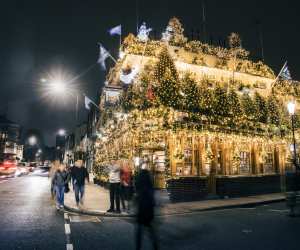
It was an aspirational book, Buttery agrees, and even today, in our cynical, late capitalist age, Dickens’ description of Christmas shopping is a seductive one: “the brightness of the shops where holly sprigs and berries crackled in the lamp heat of the windows, made pale faces ruddy as they passed. Poulterers’ and grocers’ trades became a splendid joke; a glorious pageant, with which it was next to impossible to believe that such dull principles as bargain and sale had anything to do,” he writes in that opening chapter. It sounds like a Christmas card, and that’s because the Victorians invented them, too.
And it is this – Christmas as an aspirational ideal, as well as a moral one, that led to the turkey usurping the humble goose and grander roast beef to become the star of the season’s table. When Mr Cratchit first reveals her goose, it sounds quite impressive: “Its tenderness and flavour, size and cheapness, were the themes of universal admiration,” writes Dickens. But then Scrooge awakes on Christmas morning a reformed man and resolves to send the Cratchits a turkey – a prize turkey, twice the size of Tiny Tim – and it pales into insignificance next to this big, bountiful, exotic bird that back then only wealthier urbanites could afford. “Goose was what you ate if you were poor. You had ‘goose clubs’, particularly in urban areas, which you would pay into throughout the year (thus saving for a goose come Christmas) and they were often held by landlords of pubs [which] some people didn’t like. They were associated with looseness and drunkenness,” Vogler tells fellow historian Peter Moore on the Travels Through Time podcast.
Scrooge’s poultry gift had a moral dimension, being born of wealth rather than drunkenness; but it had a class dimension too. “We were – still are – an aspirational country, and turkey became bound up with aspiration,” points out Buttery. Sure enough, by 1861, Victorian food writer Isabella Beeton writes in her seminal Mrs Beeton’s Book of Household Management: “A Christmas dinner, with the middle classes of this Empire, would scarcely be a Christmas dinner without its turkey, and we can hardly imagine an object of greater envy than is presented by a respected portly pater familias carving, at the season devoted to good cheer and genial charity, his own fat turkey and carving it well.”
So what about the rest of Christmas dinner? The sausages, the sprouts, the mince pies and mulled wine – did Dickens dictate these delicacies too? One iconic scene suggests he might have. When the Ghost of Christmas Present – everyone’s favourite ghost, surely – appears, he is seated on “a kind of throne [of] turkeys, geese, game, poultry, brawn, joints of meat, sucking-pigs, long wreaths of sausages, mince-pies, plum-puddings, barrels of oysters, red-hot chestnuts, cherry-cheeked apples, juicy oranges, luscious pears, immense twelfth-cakes, and seething bowls of punch [with] delicious steam.”
If you took the Christmas pudding away, that is a romanticised drawing of a medieval celebratory feast
This image has been replicated time and again in books, films, stage productions and, yes, Christmas cards – yet while historians differ on just how much influence the author had on the pudding and poultry, they draw a line at defining everything. “If you took the Christmas pudding away, that is a romanticised drawing of a medieval celebratory feast,” Buttery explains, which the Victorians idealised as much as some now idealise the Victorian Christmases.
“We have a tendency to gloss over the hare, the brawn, the game and just focus in on what we know,” Gray agrees. “But [that scene] didn’t change anything. It just codified what was going on. It’s like saying Prince Albert invented the Christmas tree, when that was already going on around the world. If it hadn’t been Dickens, it would have been someone else. It’s just that Dickens was a widely read author.” He was steeped in the culture at the time – a time when families still often read to each other aloud – and he is steeped in the culture of today. Not a December goes by without another literary spin-off and multiple stage productions of A Christmas Carol.
And perhaps that’s why the idea of his extraordinary words, his heartfelt belief in the ‘spirit’ of Christmas shaping our customs today holds so much appeal: because we want to feel a sense of continuity with the Christmases that have gone before. We like, amid the blizzard of naked consumerism, to be reminded of what Christmas is ‘really’ about. And we like that that reminder comes not just from John Lewis adverts, but from a man who knew a good time as well as a good deed; whose Ghost of Christmas Present shows Scrooge what an honourable family celebration looks like, whilst at the same time – as Gray gleefully points out – “upholds one of the most time-honoured festive traditions of all: getting wankered.”