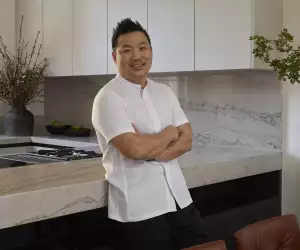
There are few foods quite as democratic as the dumpling. They can be steamed, boiled, fried, folded, pinched, pleated and passed around a table until everyone has had one too many. For Sandy Tang, co-founder of premium chilled dumpling brand Love Sum, they’re also a way of telling a much bigger story.
Originally from Macau and a finalist on MasterChef 2020, Sandy grew up between British and Macanese food cultures, surrounded by the kind of cooking that naturally blurred borders. With Love Sum, she’s bringing that perspective to the UK’s fridges, making restaurant-quality dumplings that are as easy to cook at home as they are satisfying to share.
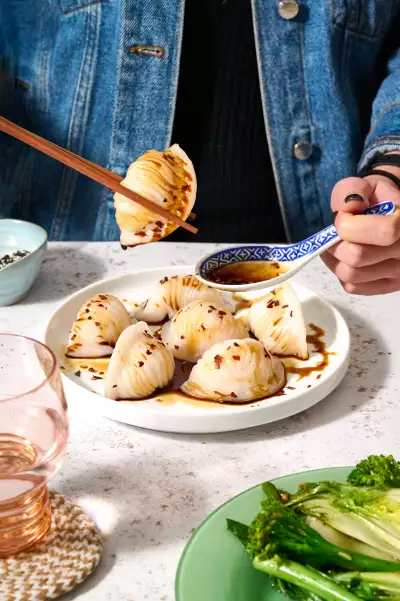
Love Sum siu mai
Foodism: You grew up between British and Macanese food cultures. Was there a moment when you realised those influences had shaped the way you think about food?
Sandy Tang: There wasn’t a single moment, I guess it was just how I grew up! Food was always central, and it naturally moved between cultures and traditions without much thought.
Some of my strongest memories are of Sunday dim sum: busy tables, bamboo steamers arriving non-stop, and everyone reaching in for their favourites. There was always a bit of friendly competition over the last dumpling.
Those experiences shaped me early on. They made me realise that food is never just about what’s on the plate - it’s about generosity, connection and the feeling around the table.
Foodism: Macanese cuisine is still relatively under the radar in the UK. How has that heritage influenced your approach to flavour and cooking?
Sandy: Macanese food is a true blend of cultures, shaped by centuries of East meeting West in Macao. Portuguese, Chinese and Southeast Asian influences sit side by side in a really natural way.
Growing up with that made me think less in terms of fixed cuisines and more about how flavours travel and evolve. That curiosity still shapes how I cook today.
It’s also why I’m drawn to foods that exist across cultures in different forms. Dumplings are a perfect example. You see them everywhere, from jiaozi and momos to pierogi, manti and ravioli. Different traditions, same core idea.
Foodism: You’ve said texture is one of the most underrated elements in cooking. What makes a truly great dumpling?
Sandy: It’s all about balance. The wrapper should be tender but structured enough to hold a juicy filling, and nothing should dominate the other.
Texture is often overlooked, but it’s what makes food memorable. Flavour brings you in, but texture is what keeps you going back for another bite.
We're quite obsessive about those details! Dough hydration, elasticity, the way it’s produced. Those technical choices are what create a genuinely great dumpling.
Foodism: You’ve described dumplings as ‘the next pasta’. What do you mean by that?
Sandy: It’s about where dumplings are in their journey. Fresh pasta wasn’t always an everyday supermarket staple, but once quality improved and people saw how versatile it was, it became part of the weekly shop.
Dumplings feel like they’re at a similar point. They’re incredibly versatile - steamed, pan-fried, in broth, or as part of a larger meal - but many people still see them as something for restaurants or takeaways.
We believe they deserve to be everyday food, something you naturally keep in the fridge and have fun building delicious meals around.
Foodism: You’ve talked about dumplings being about togetherness. What do you think it is about food that makes it such a powerful way of bringing people together?
Sandy: Food creates a natural pause in the day. It’s a moment where people sit down, slow down and connect properly.
Dumplings especially are made for sharing - you order lots of different types, pass plates around and try each other’s favourites. There’s a generosity built into that way of eating.
One thing I’ve noticed is that dumplings are often reduced in the UK to gyoza, but that’s just one version of something that exists in many cultures. We want to gently broaden that view and remind people there’s a whole world of dumplings beyond that - different techniques, histories and traditions, all built around the same idea of sharing food at the table.