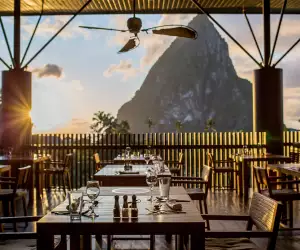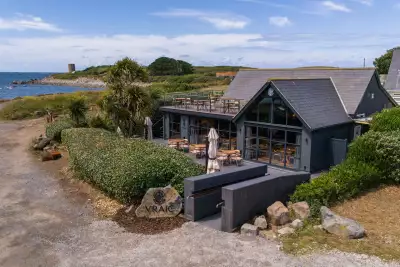
A restaurant like Vraic reveals a minor flaw in Michelin’s guidelines. With their tyre-based origins, Michelin’s stars reflect the car journey you’d make to get there. One star is worth a stop, two stars the detour, while three is worth a special journey. So where does that leave Vraic? At the time of writing – before the 2026 announcements – this deserving newcomer remains unrewarded. Based on my experience (and those of other writers and great chefs), Nathan Davies and team should be making wall space imminently for that distinctive red and white plaque. The question mark is over how many because, well, it’s in Guernsey, innit? (Note: Vraic received a Michelin star in 2026).
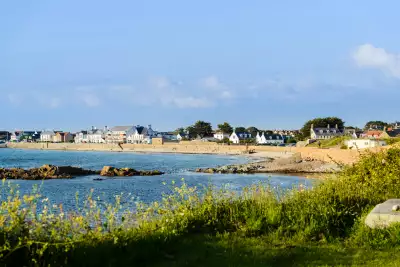
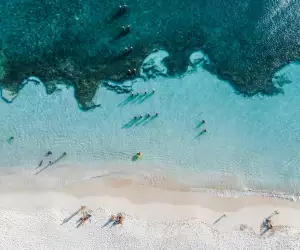
Cobo beach
Before the island’s 65,000 inhabitants take up arms, let me explain. They’re the only people who can simply stop at Vraic, or make a detour to get there – well, as much of a detour as you can on an island that’s 10 miles long and five wide. For the other eight billion people on the planet, Vraic means making a specific journey. Actually, it means “seaweed”, but we’ll get to that. It is, at least, a journey worth making, both for such culinary rewards and the pleasures of this lovely island.
Depending on your starting location, the flight, of which there are around 14 a day from the mainland, takes around 60-90 minutes. The airport is tiny, so it’s mere minutes from landing to car hire, even if, like ours, the “desk” is actually a van in the car park, where I’m handed the keys to a car so tiny I fear I’ll be wearing it like a t-shirt. It proves, however, the perfect vehicle for the compact Guernsey, as a complete lack of motorways and A roads means journeys – rarely more than 25 minutes whatever the distance – involve residential streets and very narrow, hedge-lined lanes. Parking, incidentally, is free across the island.
On first glance, it seems an unlikely setting for a restaurant such as Vraic, but a few hours immersed in local life and you realise it’s the only possible setting for a restaurant such as Vraic, not least as, to paraphrase Sesame Street, this pleasing weekend was very much brought to us by the word "seaweed".
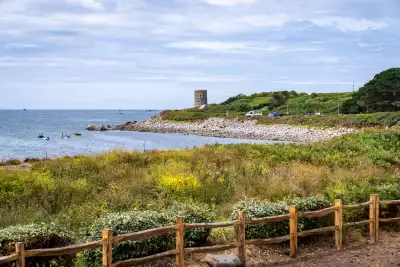
Coastline near Vraic
Our first stop is St Peter Port – or “Town” as locals refer to it – the island’s capital, and a fine place to explore with its winding alleys, little passages, steep cobbled streets, shops, museums and restaurants. We’re due to go seaweed foraging with local guide Dave Bartram, and with an hour to kill, we divert to Coco, a bustling little bistro on the front for hearty bowls of house-made, thick, rich San Marzano tomato soup, and a crab chowder so dense with fish I could stand my spoon up in it. It’s a damned fine start, and warming fuel before a yomp across the beach with the very informative Dave.
A former banker, telling visitors about the joys of his adopted homeland is Dave’s enthusiastic retirement gig and he packed in a lot of information in a short space of time, partly due to our other commitments, and partly due to the imminent arrival of the English Channel: Guernsey has the fourth highest tidal differences in the world so when it comes in, it really comes in. The other key statistic is that Guernsey’s 30-mile coastline is home to around 750 different types of seaweed. We taste a few on the tour, because, as Dave explains, “seaweed has more vitamin C, calcium and iron than milk and spinach.” We’ll also sample some of the following day as a botanical in some of the Channel Island Liquor Co’s range, and even wash in the stuff, thanks to Guernsey Seaweed’s shower products.

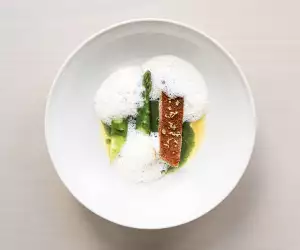
Burnt meringue desert at Vraic with sea buckthorn
Mostly though, it’s Vraic where the seaweed-alchemy takes place. As mentioned above, the word means seaweed in Guernésiais, Guernsey’s old, based-on-Norman dialect. It’s a dialect that almost died out following the island’s invasion during WWII, when evacuated children returned around the UK with different vocabularies, but there are attempts to keep it alive. There’s an excellent exhibit about this at the fascinating Guernsey Museum & Art Gallery, while this whole era of island life is brilliantly portrayed by the delightfully eccentric, cash-only, only-open-for-three-hours-a-day German Occupation Museum. But I digress…
As head chef Nathan Davies explains, in this instance, the word “vraic” also represents their connection to their location, as they work with local seaweed foragers, farmers, and fishing boats to source ingredients for this one-sitting, shared, multi-course tasting menu. The ethos continues to the room, with its emphasis on natural light, materials and colour palette: even the butter knives have dried seaweed handles.
All of this wouldn’t mean a thing, however, if the meal wasn’t as seriously bloody great as it is. More than that, it’s all delivered with a sense of fun. The open grill is mesmerising, the playlist full of unexpected delights, staff are efficient, friendly and amusing, while Nathan tells the room to “eat the bread like nobody’s watching” and gently instructs us to “drag it through the sauces.” This is not some wanky altar to the Gods of “faine daining”. This is a place that knows the importance of moppy-up bread and delivers food – and a mood – that leaves you in a far better place.
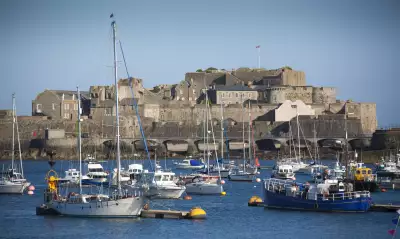
Castle Comet, Guernsey
The menu is minimalist, with dishes such as seaweed crab hazelnut, turbot cockles broccoli, or apple sunflower sorrel. While the latter sounds like Chris Martin’s Christmas card list, it’s what Nathan calls “the cheffiest thing on the menu,” an achingly beautiful dessert that’s painstakingly tweezered into place by almost the entire team. “Well,” says Nathan, “this lot has been carrying me for ages…”
No description does the dishes justice, though, as there’s endless depth of flavour that shows the thought, precision and inventiveness of Nathan and team. There also isn’t a day that couldn’t be improved by a sip of the life-affirming elixir that’s called, simply, ‘seaweed broth’. “There are 15 different seaweeds in that one,” Nathan tells me, describing the broth’s creator, Ben, as their official “chef de seaweed.” There’s a rich vein of sustainability too: the postscript to the turbot dish is a square of the skin, grilled until crispy, and served with a dip I didn’t notice because, frankly, I was doing a little happy dance in my chair.
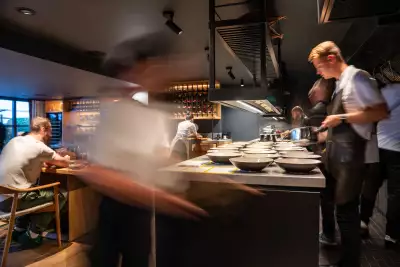
Vraic
While our other eating on the island doesn’t hit Vraic’s heights, it certainly suggests that Guernsey is punching above its weight, and supporting its producers and fishing industry, be it the crowd pleasing Mediterranean fare of Fifty Seven, a robust Sunday lunch with a view at The Puffin & Oyster or, particularly, very decent ramen and sashimi at Fukku. The latter has just been added to the Michelin Guide, one assumes / hopes whichever inspectors visited the island to check out Vraic…
What’s that line about good things coming in small packages? It might have been written with Guernsey in mind.
For more information visit visitguernsey.com