It’s a question that, I’m sure, has bothered many of you over the years: what kind of beer does ex-Led Zeppelin frontman Robert Plant like?
Happily, I know the answer. I asked him myself at the launch of Beavertown in 2012. The brewery – then based at the back of Duke’s Brew and Que, a restaurant in De Beauvoir – was founded by Plant’s son, Logan, and a Kiwi pal and I ended up chatting to Plant’s exuberant Welsh PA at the bar. When the Led Zeppelin man came over to say goodnight, I inquired as to what he’d made of Beavertown’s beer.
“Pretty good,” he said, “although they could do with a mild.”
In Plant’s native Black Country, mild was once a quasi-religion – and you can still find it in the region’s best pubs. Back in 2012, Beavertown was a lot more traditional, too, inspired by this very heritage: Neck Oil was a best bitter, named for a phrase apparently used by Logan’s grandfather, and all three original beers were cask ales that night.
A lot has changed. Beavertown is now owned by Heineken, Duke’s Brew and Que is long gone, and Neck Oil is an American-style keg pale ale, found on bars up and down the land. As a metaphor for modern London beer, that’s pretty spot-on – but there are still echoes of regional British traditions in the capital’s America-obsessed, flavour-fanatical beer scene.

Beavertown's Neck Oil was formerly a best bitter, before being reimagined as an American-style keg pale ale
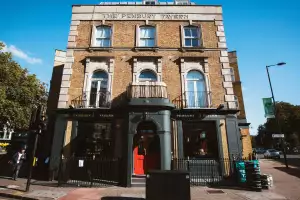
Just over a mile away from the former Duke’s in Hackney Downs, for example, is the Pembury Tavern. This is the flagship pub for the Five Points brewery, and the best place to drink their marvellous Best Bitter. Drunk at the Pembury, it mixes Kentish flavour – all the hops are grown at Hukins down in Kent – with Yorkshire tradition: the beer is served through a little plastic widget called a sparkler, rendering the head thick and creamy.
That the Pembury is a little Yorkshire outpost is no surprise, perhaps, when you consider that co-owner Ed Mason lives in Leeds. Indeed, he runs some of the city’s best pubs; most notably Whitelock’s – the “very heart of Leeds”, according to John Betjeman – and the recently re-opened Victoria and Commercial, which is operated in cahoots with Kirkstall Brewery.
It’s not Kirkstall’s only London link. This Leeds brewery makes Allsopp’s beers, which can be found at the Blue Stoops, the brewery’s flagship pub in Notting Hill. These are very traditional beers, in the main, inspired by the brewery’s origins in Burton-upon-Trent and made with English ingredients – with the exception of the reinvented Double Diamond, ubiquitous in the 1970s and now basically an American pale ale (and much the better for it).

Ansbach & Hobsday's London Black
Anspach & Hobday, meanwhile, are probably best known for their nitro porter, London Black, but they too have plundered regional tradition for inspiration. Danelaw, a recent collaboration with Denmark’s Væskebalencen Bar & Bottleshop, is a Brown Ale in the old north-eastern style – and their wet hop beers, like Five Points’, lean heavily on Kentish hops.
You can even find mild if you know where to look. Until relatively recently, indeed, one of London’s most unique hype beers was a mild, made by Boxcar in the East End – but they’re one of a number of excellent breweries we’ve lost since that spate of closures that attended Covid-19.
There’s more mild around now than for many years, happily. My favourite beer event of last year was at the King’s Arms in Bethnal Green: a tap takeover by Derbyshire’s Thornbridge, featuring their delightful Strong Dark mild. Soon, hopefully, it’ll be much easier to get, as Thornbridge is opening its own pub, the Wild Swan, on Fetter Lane in the City. If Robert Plant is still looking for a pint, that’s where I suggest he starts.