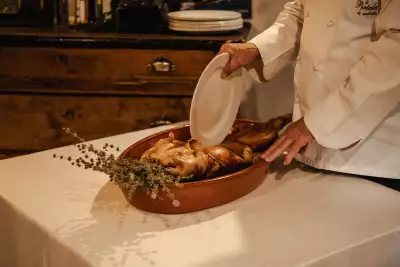
"We call it crème brûlée skin, or crema catalana,” says Nieves Barragán Mohacho, gesturing towards the delicate, crisp outer layer of the suckling pig, fresh from the oven. “It has to be very thin, crystal clear and a golden colour. When it’s golden, it’s perfect.”
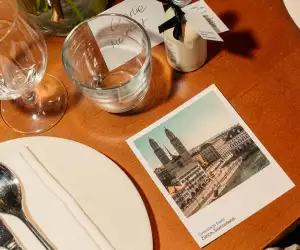
Barragán cooks her suckling pigs precisely this way at Legado, the restaurant she opened in Shoreditch last summer. But today we’re in Segovia, a historic city northwest of Madrid whose old town is a Unesco World Heritage Site. Some visit for its Roman aqueduct, fairytale castle and Gothic cathedral; we’re here because it’s the birthplace of the cochinillo, or traditional roasted suckling pig.
“A suckling pig on the table means happiness,” says Barragán, who’s been visiting Segovia since she was a child and has served the dish in London since opening her debut solo restaurant, Sabor, in 2018. “It’s about sharing and having fun. People think it’s rich, but it’s a succulent, light meat. It’s clean and elegant.”
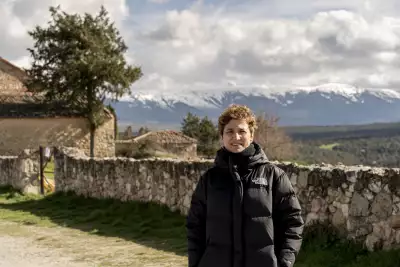
Nieves Barragán Mohacho in Segovia
Eleonora Boscarelli
To discover more about its origins, we’ve come to Mesón de Cándido, a traditional restaurant that has sat at the foot of the towering aqueduct since 1786. It’s a sprawling, maze-like place adorned with artefacts and photos of all the famous people who have visited, from Spanish kings to Cristiano Ronaldo and Mick Jagger.
“I came to this restaurant for the first time when I was about 12,” says Barragán, who grew up in Bilbao and often stopped in Segovia en route to Extremadura for holidays with her parents and younger brother. “It’s such an historic place, with so much energy. You can feel how old it is – it gives you goosebumps.”
In the centre of the dining room, third-generation chef Cándido López Cuerdo is standing over a whole-roasted suckling pig in a terracotta pot. He’s delivering a short but impassioned speech about the animal he’s about to serve, projecting his voice as if on stage. At the end of his performance, he ceremoniously cuts through the delicate crème brûlée skin with the edge of a plate, before tossing it onto the floor, where it smashes into pieces.
Using a plate to slice through suckling pig is commonplace throughout Spain, but it was here at Mesón de Cándido that the tradition was born. It’s said the original Cándido López, grandfather of today’s chef, didn’t have a knife to hand, so he cut the meat with a plate, before accidentally dropping it. Smashing is optional, but the custom of cutting with a plate has become symbolic of just how tender the pork is.
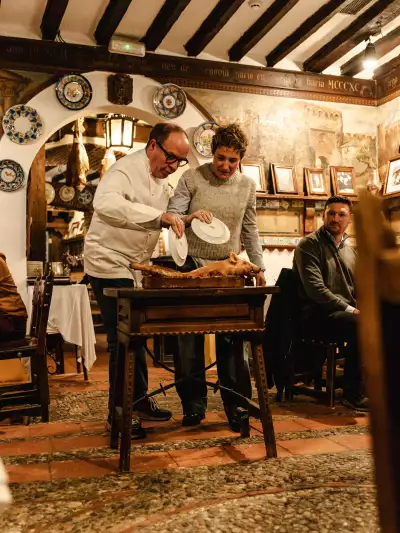
Nieves Barragán Mohacho cutting the pig
Eleonora Boscarelli
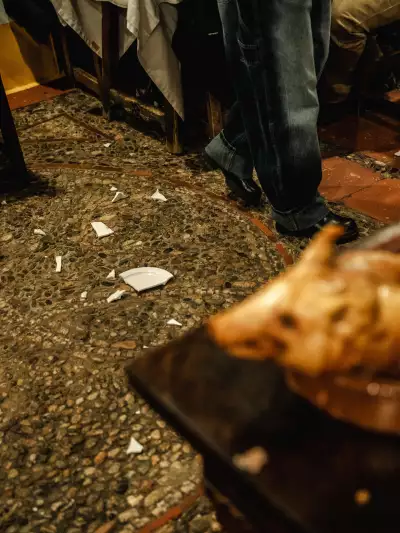
Broken plate after the cutting
Eleonora Boscarelli
At Legado and Sabor in London, servers stop short of smashing crockery, but using china to slice the pig is practical: the bones are so young and soft that a knife can get stuck in them, whereas a plate comes out clean. It’s also an opportunity for staff to talk about regional Spanish culinary traditions – which, after all, is what Legado as a restaurant is all about.
“The idea was to have a restaurant where you have the full package of Spain’s gastronomy,” says Barragán, who made her name in London at the helm of Barrafina. “It’s not only about croquetas and tortilla.”
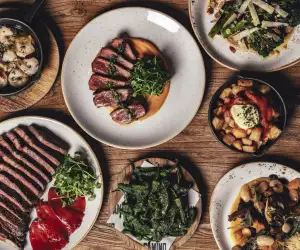
Legado, meaning ‘legacy,’ serves lesser-known dishes from all over Spain, with an extensive menu covering everything from crab rice to cod meatballs in jamón broth. Segovia is well-represented, with a whole section dedicated to pork – think crispy suckling pig ears or a quarter hog with all the best trimmings.
Achieving the perfect cochinillo starts with a quality product – Barragán buys only the ‘crème de la crème’ from Tabladillo, a family-run business outside Segovia’s centre
Achieving the perfect cochinillo starts with a quality product – Barragán buys only the ‘crème de la crème’ from Tabladillo, a family-run business outside Segovia’s centre. While in English we mostly use one term, the Spanish language makes a distinction.
Lechón, from leche (milk), refers to a more mature piglet that’s been weaned and is usually slaughtered between two and four months, weighing between 8 and 20kg. Cochinillos are slaughtered between two and six weeks and have been fed exclusively on their mother’s milk, which makes their meat extra tender.
“It’s very important the pig is fatty, not skinny,” explains the chef, who buys cochinillos weighing between 4 and 5kg. “It must be well-fed, on its mother’s milk only. It has no bruises.”
Of course, there are ethics to consider. Food critic Jay Rayner questioned the morality of eating a piglet prised away from its mother’s teats. But if you’re going to eat meat, you could do a lot worse. Tabladillo’s animals are raised with minimal stress, in a way that’s infinitely more respectful than the chicken shop fare we rarely question. Barragán’s response is to use the whole animal, thereby respecting it. And besides, she says, “It’s our culture.”

Mountains of Segovia
Eleonora Boscarelli
Indeed, the tradition of eating roasted suckling pig has existed in Spain since Roman times, initially as a status food served in royal banquets. By the 20th century, it was mainstream, its appeal accelerated by Cándido López’s plate-smashing.
These days, it’s popular in London too, with chef Santiago Lastra serving a sharing dish of whole confit suckling pig at the fine-dining restaurant Kol, and Portuguese chef Kim Hernandez preparing acorn-fed leitão (Portuguese for lechón) at Luso. Early in her career, Barragán worked at St John, where nose-to-tail master Fergus Henderson famously serves everything from pig’s cheek doughnuts to whole pig’s head.
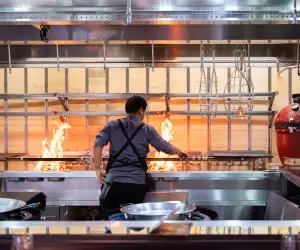
After sourcing the right meat for your suckling pig, you’ll need a proper Segovian brick oven – Barragán had one specially made at Legado, with stone and clay lining the interior to retain heat. Next, you need good wood; she uses chestnut or birch at both Legado and Sabor.
"There’s no technique – it’s about experience and watching the colour"
Quality terracotta dishes are essential, with a lip for pouring out the remaining juices. “Then, you need patience and dedication,” she says. “There’s no technique – it’s about experience and watching the colour. You might need to put a bit more wood at the front or back of the oven – it’s about paying attention.”
We see this level of patience at La Portada de Mediodía, a restaurant in Torrecaballeros, Segovia province, where restaurateur Gregorio Rico installed the oven right next to the restaurant’s front door so that diners see and smell the roasting pork and lamb from the moment they walk in.
A chef spends all morning at the mouth of the 30-year-old oven, tending to the meat with an extra-long, steel paddle, until it’s just right. At Legado, a dedicated chef cooks suckling pigs and lamb from 8am to 12 o’clock for lunch service, and for another four hours over dinner.
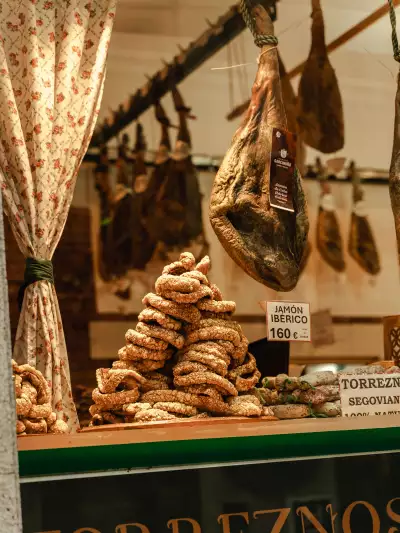
Jamón sitting in a shopfront window
Eleonora Boscarelli
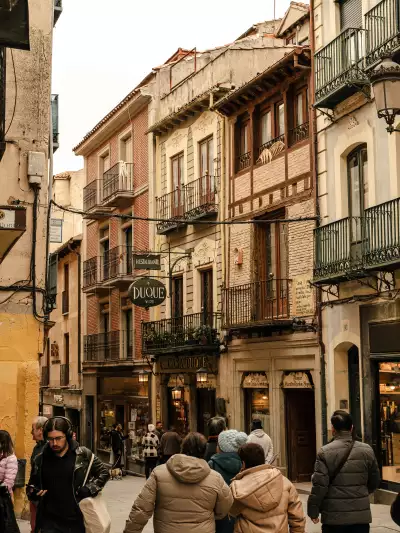
A Segovian street
Eleonora Boscarelli
Though it’s certainly the most prominent part of Segovian cuisine, suckling pig is not the only local culinary heritage. Another popular dish is judiones, a rich stew of large white beans that are grown in the area. Each restaurant has its own spin on it, but it’s usually served in a clay pot with chorizo and blood sausage.
One dish that Barragán knew she had to recreate at Legado was ponche segoviano, a cake painstakingly crafted with layers of sponge soaked in sugar syrup, plus egg yolk custard and a marzipan topping. To finish, it’s scorched with a hot iron to create a distinctive pattern.
While pretty much every restaurant in Segovia serves suckling pig, it’s worth visiting some more casual spots while you’re there, too. Just up from the main square is La Tropical, a traditional café-bar with heaped trays of fresh churros on display in its windows. Skip the hotel breakfast and pop in for sweet, milk-drenched torrijas, and churros dipped in thick, rich liquid chocolate.
Barragán’s favourite spot is Restaurante José María, a lesser-known jewel with a pintxos-style bar up front serving collagen-thick ham broth, pan con tomate and tiger-style mussels, served in their shell with bechamel sauce. There’s a sit-down restaurant for grilled octopus, squid in its ink and (you guessed it) suckling pig, though Barragán loves to visit for the bar snacks. “It’s the place I could go to every day,” she says.
Ultimately, though, if you only have a couple of hours to spend in Segovia, you’ll never regret stopping for a suckling pig. When she goes home to visit family, Barragán often flies to Madrid and goes straight to Segovia for roasted cochinillo before driving north to Bilbao.
“It’s incredible to see that every single restaurant here does the same,” she tells me. “It shows you how important suckling pig is for the people here. When Cándido put on that show for us, it was like he was blessing the pig… you don’t see anything like that around the world. It’s a unique experience. When you eat it for the first time, it must be like ‘wow’.”