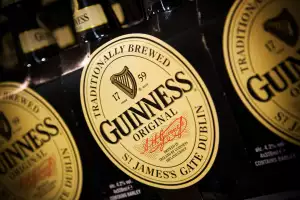
To be Irish in London is to be forced into conversations about Guinness. It’s being told by British people how good the pint they had in Dublin was, and being assumed to have some innate ability to split the G perfectly every time, guided by Irish mysticism alone. I’ve had some variation of this encounter, at least twice a month, since moving to London just over two years ago.
This is by no means a large, or even minor, imposition. But, well-intentioned or not, it’s not especially exhilarating pub chat and, at least in my experience, there can be a hollowness to it. British ignorance, which historically meant a failure to recognise Ireland as a separate entity, is more recently taking the form of failing to view Irish culture as existing beyond the realm of social signifiers.
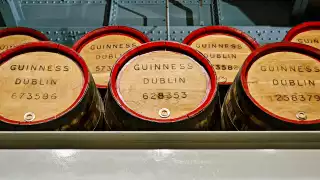
Guinness barrels
Second only to its limited scope as a pub topic is its inexplicable popularity in British column inches. You know the story by now: everyone in London drinks Guinness, there’s a shortage at Christmas, men with mullets go on about it. You’ll now find multiple Guinness-inspired hot takes at almost every British national newspaper, all written in the past two years. First came the ones tying its newfound ubiquity to some new semblance of Irish cultural soft power, and lately the ones decrying its popularity, telling us Guinness is now ‘over’, and giving us the low-down on the firebrand new stout ready to knock it off its perch (Murphy’s; established in 1856). And yet, here we are. Is another Guinness column acceptable if it’s about Guinness columns themselves? Probably not, but it might be fun nonetheless.
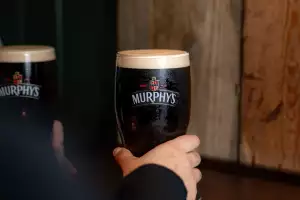
New openings like Nancy Spains and The Hart have started to serve Murphy's as a point of difference
If it hasn’t happened already, we’re about to hit peak Guinness saturation, pushed to the brink by the imminent Covent Garden brewery and the release of House of Guinness, which treats 19th-century Ireland with the level of nuance you might expect from the creator of Peaky Blinders. ‘Guinfluencers’ have mutated from accounts making light-hearted in-jokes about the reality of one of Ireland’s most common shared experiences – emigration – to an entire industrial complex led by English men travelling the world in search of the best pint.
To an Irish person in London, it’s hard to explain just how strange the discourse is: a 250-year-old stout that’s been launched into the centre of the food conversation in London and New York. At the best of times, I feel a little like Gabriel Conroy from The Dead when I go home to Dublin, desperately fending off West Brit allegations as I absentmindedly refer to currency in pounds, higher education as ‘uni’, and excessively use the word ‘mate’. But no more so than when I tell my family Guinness is having ‘a moment’ across the water. It’s incomprehensible, as if I said everyone in London is now obsessed with trees, or oxygen. Now, when I gravely report that the moment has passed and we’re entering into a Guinness backlash era, bafflement gives way to something approaching real concern.
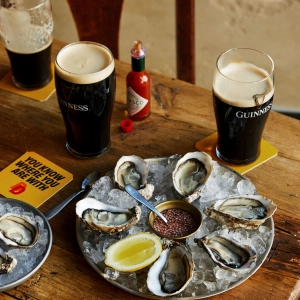
Guinness at the Knave of Clubs
Several reasons for its explosion in popularity in London have been put forward, although the idea that Guinness has risen from a fringe pint to status symbol doesn’t quite tell the story. Diageo has been marketing the stuff aggressively for decades, and had Jonathan Glazer directing its ads in the 90s (Surfer arguably remains its most famous today).
However, its place in the public consciousness has not occurred independently – it ties into something Irish author Róisín Lanigan has written about, a sort of flattening of Irish culture that impersonates itself as a glow-up. Guinness, as well as Tayto crisps, spice bags and Hollywood heartthrobs, Lanigan says, is “a form of green soft power that is irritatingly flat, a reputation that doesn’t quite reflect reality”. London has thrown itself headfirst into them all, but the truth is, there’s a lot about Ireland that still makes a lot of British people uncomfortable – just ask Kneecap or Sally Rooney. Seeing it as a land of pints is much more palatable to engage with, which is why being dragged into never-ending chatter about pints of Guinness can be so grating.
London has thrown itself headfirst into them all, but the truth is, there’s a lot about Ireland that still makes a lot of British people uncomfortable – just ask Kneecap or Sally Rooney. Seeing it as a land of pints is much more palatable to engage with, which is why being dragged into never-ending chatter about pints of Guinness can be so grating
It’s not lost on me that, to keep the industry I earn a living in going, we do need to fill column inches with something; so why not the formerly old-man pint that has Gen-Z in a chokehold? There’s probably an interesting piece out there about how the aggressively marketed Guinness is emblematic of a 21st-century Ireland that has managed to sell itself both as a land of mystical romanticism to American tourists and as a tax haven to American corporations. Or about how a generation, driven to arrested development through a combination of housing and cost-of-living crises, has increasingly begun to define itself through its consumption habits.
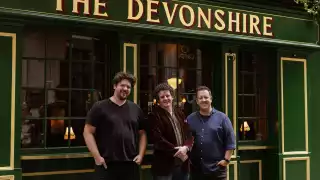
The Devonshire: the scene of many a Guinness mansplain
But no matter how many columns I read, I’m yet to even tenuously grasp what Guinness being over actually looks like. Or, really, what made it such an interesting topic in the first place. Maybe I’m blinded by patriotism, but discussing it like it’s just another ephemeral trend on a boom-to-bust track doesn’t quite hit the mark. Somehow, I get the feeling that the post-Guinness London pub scene will still look a little like it does today; a sea of creamy tops and dark stouts, just with less impassioned fervour. It’s been going strong for 250 years; it’ll take a little more than Chris from Buckinghamshire going on about it in The Devonshire to torpedo its popularity. Sure, getting preached at about stout for half an hour sounds like the Hinge date from hell, but surely getting preached at by a dose about anything is the same?
But if you believe the obituaries and are convinced that Guinness is dead, Guinness remains dead, and we’ve killed it. The potential heirs to the throne? Universally beloved national treasures James Watt and Jeremy Clarkson have released their own stouts in a naked attempt to jump aboard the bandwagon. Ye can comfort yourself with that, I suppose.