What does it mean to cook with love? Naively, for a while, I thought I knew. I’d written a book about food and love, interviewing anthropologists, psychologists and historians. I’d penned articles, hosted panel talks, and preached the gospel of food forging connection at every turn. Then one day, I came to bake my grandma’s beloved millionaire’s shortbread for the first time, and the scales (together with a fair few tears) fell from my eyes.
Reader, I hadn’t a clue – not just how to make millionaire’s shortbread, but how much time, skill and effort my grandma had put into making it for us; how inextricable its fudgy caramel, smooth chocolate and buttery base was with her care and affection.
I burned the caramel twice; burned the shortbread thrice, and in the end had to visit her to learn what I’d spent years taking (and eating) for granted. I’ve not yet mastered it, and I’m not sure I will, but the process of trying and failing myself then baking it with her proved a salutary lesson in what cooking ‘with love’ looks like.
Food writers in particular are guilty of writing about ‘love’ as if it were a mysterious magic ingredient that eludes definition
Food writers in particular are guilty of writing about ‘love’ as if it were a mysterious magic ingredient that eludes definition, but that’s true only insofar as it can’t really be quantified. What I’ve learned from my grandma’s millionaire’s shortbread, and from speaking to friends, chefs and fellow food writers about cooking their beloved family dishes for the first time, are ways to ensure the love is in some way defined, so that the feeling isn’t lost in translation.
Lest I risk straying into the grey clouds of cliché, let me turn to Chet Sharma: a chef whose sole concession to cliché is naming his restaurant for his ‘Bibi’, his two grandmas. With a doctorate in condensed matter physics, experience at The Ledbury and L’Enclume and plenty of accolades in his own right, Chet Sharma’s startling originality speaks for itself, and there’s nothing homely or hackneyed about his menu.
“When we first opened, people would come up to me and ask, ‘Which of these recipes are your Bibi’s? And I’d say none of them, really. My grandmother was not using tweezers,” says Sharma. Yet the scientific focus and skill that he applies to his culinary heritage to create his food are not mutually exclusive with his memories of his grandmothers, and his wish to “pay homage to two of the most amazing cooks I have ever known.”
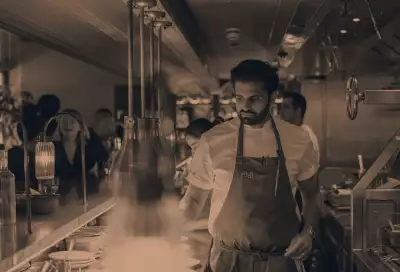
Chet Sharma at BiBi
Of course, Sharma cannot serve straight-up nostalgia; “they are my memories only. No one else has had the exact life that I have. But we do, by virtue of being a small restaurant with a tasting menu, have the luxury of giving our guests an experience that transports them in a different way.” To achieve this requires an understanding of the principles and processes behind his cuisine that goes beyond the applied and academic; that considers why people cook as they cook, and what it means to them.
“Indian food is often very labour-intensive, which links back to the fact that for many, it was their sole contribution to their family,” Sharma explains. Many Indian families had staff who helped with cleaning and childcare, in India and then – for those who emigrated there in the 1970s – in Kenya. “Women like my grandmothers, who didn’t work, could afford to spend eight hours preparing a meal because it was all they did,” he says – and for these women, food could feel like a huge part of their value. If they’d lived the life Sharma’s grandmothers had, their dishes would be a truly unique culinary fingerprint, reflecting three different continents and two centuries.
“My maternal grandmother was 15 when she moved to Kenya from the Punjab. There, she had neighbours from Rajasthan and Gujarat. She knew dishes no one else did,” he points out. “That ability to cook for and nurture her family wasn’t something she was going to hand over to anyone.”
He recalls a favourite family story, of his sister-in-law attempting to learn one of his grandma’s dishes. “My sister-in-law put her phone on top of the fridge, just to record everything my grandma showed her – and when my grandma sent her into the pantry to get something, she pulled a little pouch out from her blouse, tipped the contents into the pot, and pretended nothing had happened,” he grins.
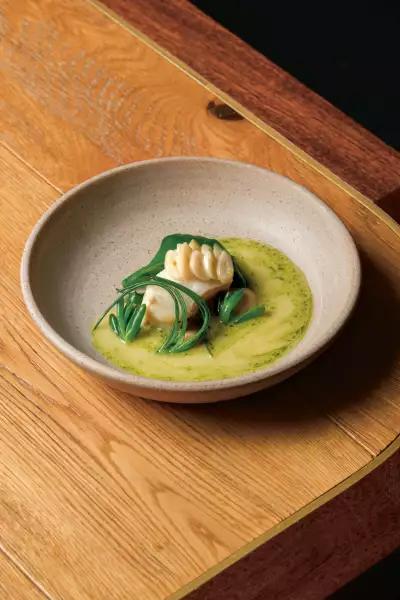
Green chilli turbot at BiBi
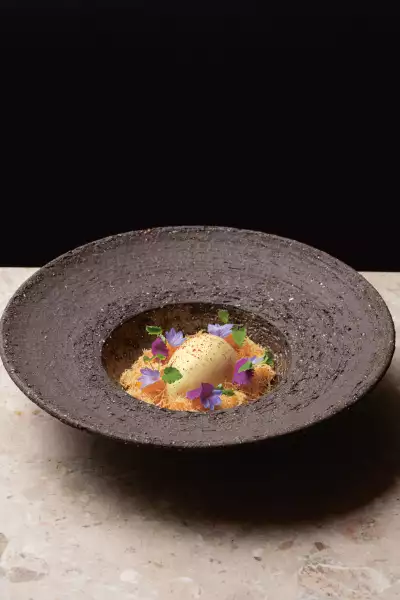
Saffron egg at BiBi
Can you taste all this in Sharma’s dishes? Not explicitly, no; but if you’re concentrating, you can taste the time, care and generational skill they have been born of. You can taste the emotional resonance, even if you don’t share Sharma’s memories.
You can taste the detail – and that’s where the heart lies, I’ve learned; in the nuances of touch, time, and tailoring for loved ones. When Maureen Suan Neo first wrote her mother’s recipes down, it was because her “memory could not retain the long list of ingredients each dish would contain,” and her mum was “somewhat fussy and used to dishes cooked in a very exacting manner, as trained by her mother.”
Suan Neo went on to run a group of Singaporean restaurants in London; those handwritten notes would become staples of her menu, then the foundation for Nonya’s Secrets, her award-winning range of sauces. Yet when I ask Suan Neo what cooking with her mum taught her, it was that “her love was manifest in every detail, pandering to our likes and dislikes whilst always ensuring that whatever we consumed was healthy and good.”
I am reminded of my own grandma – not that millionaire’s shortbread is healthy, but her love is evident in her making it for me whenever I come down, and the time that it takes her. It’s no Indian pani puri, of course, but to do it properly, you do need to slow down and get each step perfectly right before proceeding to the next: the shortbread, then the layer of caramel, then the top layer of chocolate.
“In Italian, we have this expression, Impara l’arte e mettila da parte, which means you have to learn and understand the process before you put it into practice,” says my friend Emma Marijewcyz, who runs her own PR agency specialising in food books. It applied to everything her Nonna cooked, from her polpette to her cuttlefish ragu to her tomato sauce, which she made every Sunday, and which any self-respecting southern Italian must learn to cook, as “a rite of passage.”
For Marijewcyz, learning how to make tomato sauce or indeed any dish of her Nonna’s was a lesson in “understanding that actually, most things just need patience.” This means time, but it also means “seasoning well and thinking about the quality of ingredients. They don’t have to be expensive, but they have to be selected with care and thought. That is transformative.”
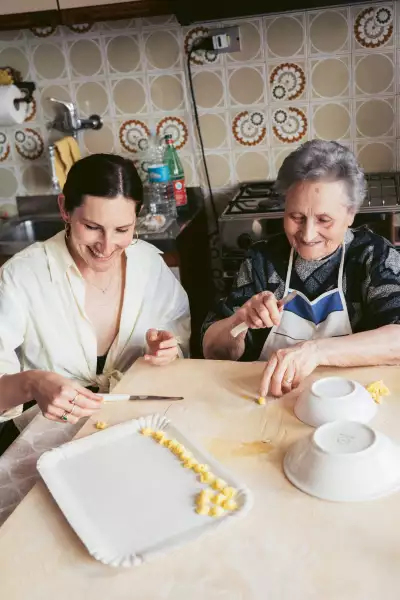
Anastasia Miari with her grandmother
Marco Argüello
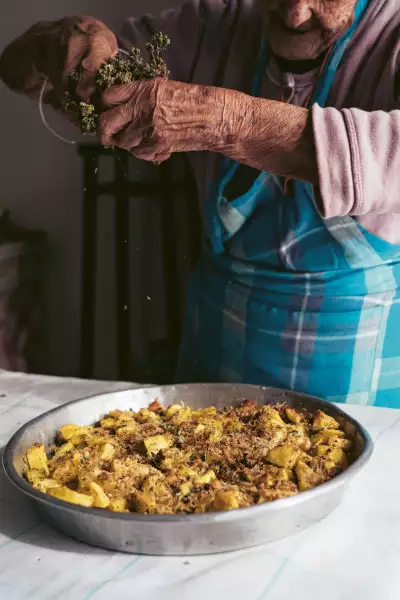
Grandmother's recipe
Marco Argüello
Marijewcyz remembers the first time she made her Nonna’s sauce, when she moved to London and wanted to recreate her Italian Sunday tradition for friends. The tomatoes were cheap and watery; she boiled them too quickly, and the seasoning was off. “I remember Nonna saying, ‘You can add salt, but you can’t take it out.’ Even now, when I oversalt, I find myself apologising to her.”
At this, I am reminded of the fairy tale that gave rise to Shakespeare’s King Lear, in which a daughter tells her wealthy father, ‘I love you as much as meat needs salt’ – and is banished for her seeming impertinence. In the story, the father learns the hard way that meat needs salt; that without it, meat is almost inedible.
To say someone gets the seasoning right every time they cook for you doesn’t sound much like love, until you think about what it implies: the attention to detail, the practice, the timeworn care taken to bring you pleasure, as well as sustenance. Far from insulting him, the daughter was paying her dad a compliment as nuanced as it was profound – for as Marijewcyz observes, seasoning ‘well’ means “knowing how to treat things just right; how to do just enough to get the best out of everything.”
These cooks’ instinctive sense of what their ingredients need often mirrors their understanding of their loved ones’ needs. The first time Suan Neo cooked one of her mum’s recipes on her own was in the 1970s, to impress her now-husband. “It was quite complex and required fresh lemongrass, galangal, candlenuts, lime leaves, shrimp paste and of course fresh chillies, shallots and garlic.
These cooks’ instinctive sense of what their ingredients need often mirrors their understanding of their loved ones’ needs
I did not pound the ingredients in a pestle and mortar the way she would have done… Instead, I invested in a food processor and ground all the ingredients in minutes. My mother did not disapprove – but hinted that it would somehow not taste the same,” Suan Neo recalls. “She felt the traditional way coaxed more flavour and oils out of the ingredients.” Her Nonya, like Marijewcyz’s Nonna, my grandma and Sharma’s Bibis, believed in things taking as long as they take: in the kitchen as in the world beyond it.
It’s a belief starkly at odds with today’s trend for simple shortcuts and one-pot meals, but it offers an invaluable insight into what cooking ‘with love’ means. When food writer and author Anastasia Miari first started recording her grandmother’s recipes, she realised how much flavour came from all the things her Yiayia had left unsaid: using a pestle and mortar to crush unfathomable quantities of garlic, being “very, very bold with the olive oil” and cooking fish on “an ancient grill, which makes for a lovely crisp, charcoal skin. It’s maybe embarrassing to admit,” Miari explains, “but I cannot recreate that in an oven at home, and I can’t put a barbecue on my balcony.”
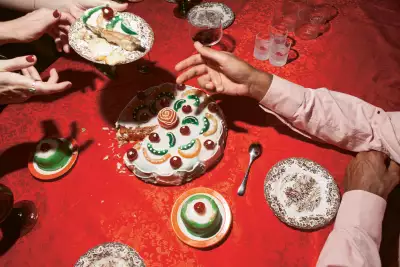
Cassata Siciliana from Yiayia
Like adding more and more olive oil to her arakas latheros (a Greek dish of peas and potatoes), the grill is “an extra special step, that means it always tastes better when Yiayia makes it,” Miari points out. Some of these steps can be outlined in a recipe, and indeed that is what Miari spent the last five years doing: compiling grandmothers’ dishes and stories from around the world for her cookbooks Mediterranea, Grand Dishes and Yiayia.
Yet it takes time and practice to know just how much olive oil a dish needs, and even if she could have one, Miari’s balcony barbecue would not have “absorbed the flavour of a thousand fishes over the years” like her grandmother’s. The steps can be inscribed, but years of cooking with and listening to grandmothers have taught Miari that their approach to food – and love – is inextricable with their experience of life. The steps can be followed to a T, but in hands less weathered than theirs, the result will always be slightly different.
At Bibi’s, Sharma has made his peace with this. “I remember a few years ago trying to recreate this fresh tomato chutney my grandma would make in summer. There was something about the way she cut the onions for the chutney that made such a difference to the taste, which we couldn’t refine for the restaurant.” That Bibi passed away in 2014. “I hadn’t tasted her chutney in maybe 14 years – but at a certain point, I knew we weren’t going to get it right,” Sharma tells me.
Some family recipes and rituals lend themselves to reinvention: it’s why he grinds Paigrambi wheat for his flat breads, just as his paternal grandma did every day; because “the smell is super evocative.” The chutney did not, and he preferred to leave it intact rather than do a disservice to his memory.
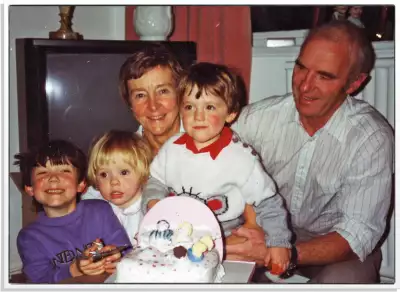
The young author with her grandparents and siblings
On my fourth failed attempt at millionaire’s shortbread, I wonder if it’s like Sharma’s chutney: a culinary white whale best left in my grandmother’s kitchen. Then Marijewcyz shows me a notebook of her Nonna’s recipes, which she’s recorded from years of their cooking and conversations. “Sometimes it was hard to communicate with her because her southern dialect is so strong, but when it came to food, we talked easily. It didn’t matter when we couldn’t physically cook together anymore,” she explains. “We were together, and talking about something that tells her story, and has shown her love. Now that she’s slowly disappearing (she had a stroke, and lives in a care home), I feel like I’m not losing all of her, because she’s leaving this with me.”
Leafing through Marijewcyz’s handwritten notes, I realise what counts far more than recreating a beloved recipe exactly is the decision to remember it, in all its colourful detail. It is surely no coincidence that all my interviewees have written down their family dishes, and the memories associated; that they have captured what Marijewcyz calls “the love on a page”.
Of course, it’s nice if those recipes go on to be published, as in the cases of Sharma, Miari and Suan Neo; but the principle is the same, whether it’s a published cookbook or something handwritten. “Even when I can’t see Nonna anymore, I will be able to pull this down from my shelf, and feel like she’s with me,” Marijewcyz goes on. “I can stand by the stove and feel that tether to her.”
My millionaire’s shortbread will never taste quite the same as my grandma’s, but the process of trying, learning with her, talking and writing about making millionaire’s shortbread has helped me capture the feeling.