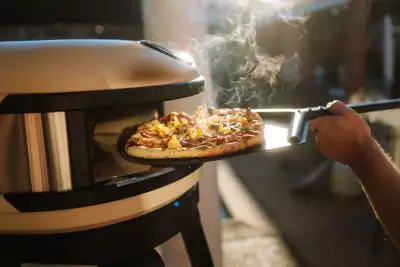
To cook pizza in a pizza oven is to live on the edge. At close to 500ºC, the stakes are high. A lack of confidence in your technique can be perilous. A Neapolitan-style pizza cooks in just over a minute; five seconds too long can leave one side blackened and burnt. If the dough is overhydrated or the stone isn’t hot enough, the base can tear and catch. But while the process is fraught with tension, when it’s going well – dough rising to meet the flames, toppings bubbling, base sliding easily on and off the paddle – there’s nothing quite like it.
“Seeing a pizza cook in a wood-fired oven in a minute was just an incredible thing to witness,” says Tom Gozney of his first experience with this type of cooking in 2009. “But I suppose the real unlock for me wasn’t the product or the output of the product. It was the experience that was had by everyone who was socialising around it.”
We’re about 15 minutes into a conversation that will last almost an hour, and, given that he was one of the people who put pizza ovens on the map for millions of consumers around the world, I’m keen to get his take on how and why the market for portable pizza ovens has exploded. The Gozney brand is now multinational and successful, but it began from humble roots. Gozney tried his hand at building an oven from scratch, spurred on by a recent commitment to get clean from drug and alcohol dependency and looking for a social ritual besides drinking to help direct nights in with friends.
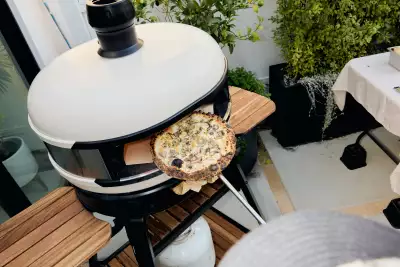
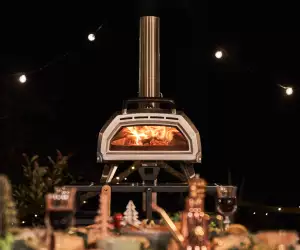
The Gozney Dome catapulted the brand into mainstream success
“One evening we made pizzas in the conventional oven,” he continues, “and the process of making them together was just incredibly fun. And while the pizzas didn’t come out brilliantly because they were cooked in a conventional oven, the process was really engaging. So the next day I decided that I wanted to buy a pizza oven for the garden.”
A noble ambition, but in the 2000s it wasn’t quite as simple as it is now, when Googling a pizza oven will bring you multiple options from reputable brands, available for next-day delivery and costing a few hundred pounds. “They were all these Italian imports for thousands of pounds,” says Gozney, “so I decided that I’d build my own brick oven in the garden.
The day after that pizza night, I started digging foundations, and a week later, I’d built a hand-built brick oven. And the most amazing thing happened when we next lit the oven and started making pizzas: the whole social dynamic shifted; my friends who had been bringing over drinks and bottles of wine a few weeks earlier were bringing toppings. So the oven I’d built really changed my life.”
That’s no understatement. The Gozney brand is estimated, in a recent Forbes article, to have posted around £75m in revenue in 2024, with Gozney still heavily involved as the de facto creative director after handing much of the nuts and bolts of the business to a wider executive team. But that eureka moment didn’t lead directly to his success.
He spent some time hand-building brick ovens for restaurants before rethinking his approach. “I realised that if I wanted to get these products in more people’s hands, building hand-built brick ovens was expensive and it wasn’t scalable.”
The day after that pizza night, I started digging foundations, and a week later, I’d built a hand-built brick oven
After researching the options available to consumers – and not exactly being blown away by the results – Gozney borrowed a small lump sum from his mum. “£2,000 went on a fibreglass mould, and £2,000 on a website,” he says. “And that was the beginning of a brand called The Stone Bake Oven Company.”
The brand’s first Primo oven was, by Gozney’s reckoning, the first of its type to cost under £500 while still delivering restaurant-quality results to, well, restaurants. This was still before the boom in at-home ovens.
But the timing was fortuitous: a few years after the financial crash of 2008 and in the first wave of street food in London, it was fertile ground for pizza, as a new breed of enthusiastic amateurs picked up paddles and bought vans – most notably James and Thom Elliot, the brothers who founded Pizza Pilgrims after the now-famous trip to Naples that gave their business its name.
James and Thom crossed over with Tom Gozney in Bournemouth before they commissioned him to build an oven for them at their first pop-up, and The Stone Bake Oven Company also built one for Franco Manca in its infancy.
“I developed a patented system where we could take a commercial oven through a doorway and install it in a day. We were the first brand to secure an exemption under the Clean Air Act with Defra, so we quickly became the market leader in commercial ovens. We had brands like Pizza Pilgrims, Franco Manca, Homeslice – loads of really, really good founder-led, artisanal Neapolitan pizza brands choosing our commercial oven. And I also realised that there was still a massive opportunity to develop a product that could be scaled.”
“They were good ovens, but they were thick and made of clay,” says Thom. The Elliots worked with various companies to install pizza ovens in their Piaggio van and at their first restaurants. “So when I first saw a Roccbox, I was like, ‘That’s never gonna work,’” he continues. “And then you use it, and you’re like, ‘That’s fucking amazing.’”
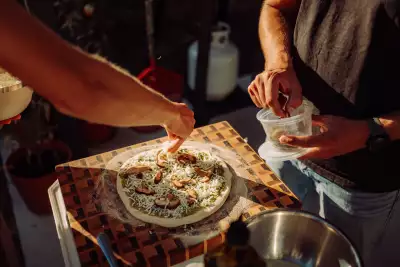
Cooking pizza at home
Ben Matthews
The Roccbox is the turning point in Gozney’s story, as one of the first modern portable pizza ovens to hit the market in the 2010s. At the same time as Gozney was developing a way to bring restaurant-quality food to the masses at home, another player had entered the game: husband-and-wife team Kristian Tapaninaho and Darina Garland.
They launched Uuni – ‘oven’ in Tapaninaho’s native Finnish – from their base in 2012 as the first portable wood-fired pizza oven, then fuelled by wood pellets. Its shiny silver design and tall chimney were a world away from the spaceship-chic looks of the Edinburgh-based Ooni range now, but they had to start somewhere.
As Tapaninaho later told tech title T3, Ooni was born from frustration that home ovens couldn’t reach Neapolitan temperatures and that existing options were too bulky and expensive; in his view, Ooni created the portable wood-fired pizza oven category in 2012.
What unified both Ooni and Gozney’s ovens was the relative ease of installation and transport. “We didn’t really do it at the time for a portability play,” says Gozney. “It was all about convenience for the consumer so they could purchase something, take it out of the box, and it was ready to use. That’s been our mindset ever since we introduced commercial ovens in the UK market: building products with the same performance as restaurant ovens. So we’ve always put extra quality, extra insulation, thicker stones, all of those types of things in our products.”
By this time, Neapolitan and other artisanal pizza businesses, whether street food vendors or restaurants, were thriving in and around London. Did the public’s appetite for a more authentic, more Neapolitan style of pizza in restaurants fuel their interest in cooking pizzas at home? It’s probably not quantifiable, but it’s a fair bet that the two interests had a decent crossover of consumers and that one helped the other find an audience.
“We wanted people to have the same experience that you would get in Naples if you were getting a pizza made by a third or fourth-generation pizza chef,” says Gozney. “That’s what we wanted to bring to the world. That was the big vision.”
In both restaurant and home formats, this type of pizza is unified by a straightforward preparation and a highly specialised cooking method. The base is generally 00 flour (milled particularly fine to suit both pizza and pasta making) with water, salt, and either yeast or sourdough starter; the tomato base is often just really good tomatoes – I use Mutti Polpa. Pop on some mozzarella and maybe a couple of torn basil leaves and you’ve got yourself something a Neapolitan – or indeed a restaurant-going Londoner – would be very happy with, if cooked correctly.
But therein lies the challenge: to cook a pizza correctly requires a level of mastery of heat and space
But therein lies the challenge: to cook a pizza correctly requires a level of mastery of heat and space. Whether cooking from a gas cylinder or with wood (I learned first on the former and now love the more organic, wild-card nature of log-fired cooking), you need to heat the stone thoroughly, usually for around 20 minutes, which ensures the base is cooked at the same rate as the roaring heat takes care of the crust and the toppings. The chef at a great pizza restaurant has cooked thousands of pizzas and is used to navigating the intense heat; an amateur may not be, at least at first.
To illustrate the point, let me paint you a picture: of a sunny afternoon in East London in 2020, a portable pizza oven lying on its back in a garden; a few yards away, a man crouching, holding his head in his hands in pure frustration, looking at an overcooked pizza base on the grass nearby in disgust. Its topping – a mesh of mozzarella and cured meat – is still inside the pizza oven, on top of a now broken stone.
The man, if you hadn’t already guessed, was me, and that was a stark early reminder that this way of cooking is highly specialised. But just as it’s enraging when it doesn’t go right, it’s a near-religious experience when it does.
“Cooking a pizza to like perfection each time – there’s just something so incredibly, physically satisfying about that process,” says Hannah Drye, founder of much-loved pop-up Dough Hands, of her time cooking in a Brighton pizzeria in the 2010s. “The line between cooked and burnt can be very fine, you’re very much on the edge there and on a Friday night when the ticket machine just explodes, everyone’s in it together as a team, and the music’s going – I just loved the environment of it. Straight away, I was sold on making pizza professionally.”
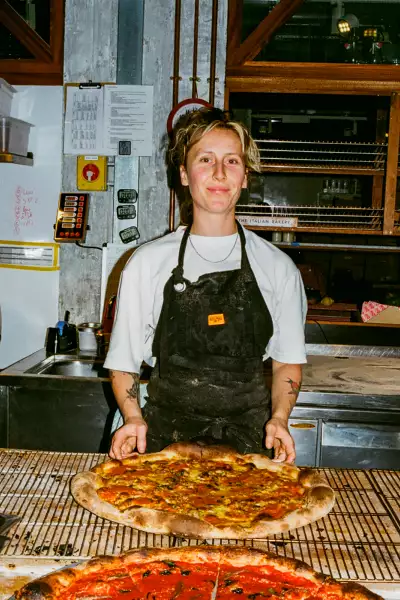
Hannah Drye, founder of Dough Hands
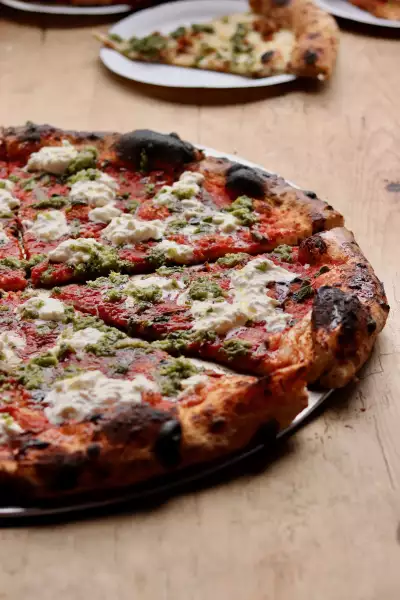
Pizza at Dough Hands
Her dream would have to wait a while – after a stint at a Neapolitan pizzeria in Sydney, she fell into a corporate career, but went back to the drawing board after losing a job in 2020. “Ultimately, I knew what I wanted to do was have my own pizza shop,” she says to me. “And then I just think it’s always that you think ‘How do I go about starting with only a couple of grand in my bank account?’”
By that time, there was a lower-cost, more convenient solution that removed the barrier to entry posed by a bespoke oven. While Ooni’s products were designed primarily for keen amateurs, Gozney aimed to bridge the gap between the professional ovens he installed in restaurants and the casual consumer following their passion to cook pizzas in the back garden.
Its army of brand ambassadors – from celebrity chefs like Matty Matheson to content creators, skateboarders and hyper-engaged punters in the Gozney Collective – is a testament to that. Drye was part of the latter; with her background as a professional pizza chef, she sought out the portability and professional-level quality of a pair of Gozney Roccboxes when she wanted to get her dream back on track.
It was a similar story for Tom Vincent, founder of Vincenzo’s in Bushey. A former teacher, he became obsessed with the ancient-looking domed ovens of Naples, then with the coal and deck ovens of New York, and started building his own backyard oven to chase that heat – an oven that got blisteringly hot but belched smoke and never drew quite right.
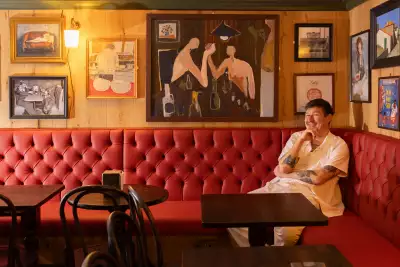
Tom Vincent, founder of Vincenzo's
JW Howard
Cooking pizza over fire, though, had piqued his professional curiosity: he went on to get a job as a pizza chef in a pub while perfecting his craft at home, and the rest is history. He opened Vincenzo’s as an ode to the pizza shops that crowd the streets of New York.
His captivation by the domed ovens of Naples was shared by Gozney, too, who wanted to build on the breakout success of the Roccbox by introducing the Gozney Dome in 2020; a large, sleek, round pizza oven beautiful enough to be the centrepiece of a garden, decidedly not meant to be portable, and inspired by the pizza ovens of Naples in its form as well as its function.
“I’d grown my career and my abilities as a designer of commercial ovens, but I wanted to take this ancient aesthetic that was so bold and irreverent – you kind of walk into a restaurant and it feels like there’s true gravity around the pizza oven, right? Leverage the heritage of where the product came from with a modern aesthetic, and then make it feel aesthetically approachable and usable,” Gozney says.
“We made it easy for consumers to understand what it was and how it performed. And I think consumers going in and eating in a restaurant like Franco Manca and seeing that large oven and then seeing a smaller version of that that came out of a box with no building, no setup – it felt like you could have that professional experience at home, and that was what we were trying to achieve. It was taking all of our engineering, modernising it, paying homage to its architectural roots.”
The Dome was a runaway success for Gozney – £8m in sales on another low-budget launch, waiting lists, and ambassadors to keep stoking the fires of excitement among its customer base
The Dome was a runaway success for Gozney – £8m in sales on another low-budget launch, waiting lists, and ambassadors to keep stoking the fires of excitement among its customer base. North of the border, the Ooni founders had built a similarly huge and passionate following on a broader range of ovens across gas, wood and pellet-fired collections, reintroducing the original Uuni’s chimney for the Fyra and Karu lines, and building larger ovens capable of cooking 16-inch pizzas or more than one smaller pizza at once.
By the early 2020s, this once-nascent market had grown into a huge industry, much of it on the shoulders of Gozney and Ooni, the two biggest players, who still split the vast majority of the market share between them. The term “Ooni bro” was an accepted shorthand for a middle-aged man who’d bought a pizza oven and was keen to show off his newfound skills.
Inserts and pizza stones for ceramic barbecues like the Big Green Egg and Kamado Joe were popularised, letting those grills hit Neapolitan-style temperatures too, while both Ooni and Gozney began to market their ovens as great for cooking more than just pizzas, through ranges of pans and accessories, cookbooks and YouTube channels.
Ooni launched the Volt – an electric pizza oven capable of cooking indoors – in 2023, while Gozney released the Arc last year as a smaller and more portable oven styled on the Dome’s looks. Even now, experts predict a compound annual growth rate of around 4.5% for the UK pizza oven market from 2024 to 2030. The fire shows no signs of going out.
The market for other brands, too, is ripe: “People throughout the UK have turned to DIY pizza not just as a way to save money, but to enjoy the cooking experience and make it completely personal,” says Amy Cheadle of Northern Dough Co. The brand, which sells ready-made pizza dough for those looking to cook on pizza ovens or conventional ovens, insists that bases are seeing the highest year-on-year growth of any sub-sector in the at-home pizza market, suggesting that even those without a pizza oven are looking to get creative with toppings.
Somewhere in between Neapolitan pizza in a pizza oven and a convenient but lacklustre supermarket pizza was Pizza Pilgrims’ Pizza in the Post, a version of the Frying Pan Pizza they’d developed in the early days and which came to prominence as a meal kit in the pandemic, where a hot pan and a grill combine to make a great version of their Neapolitan pizza without an oven.
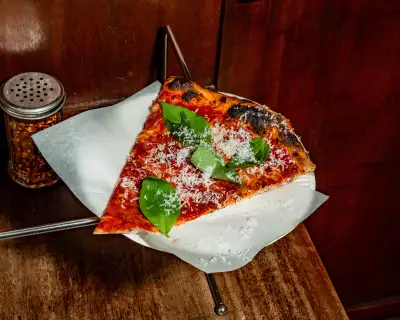
A slice of Vincenzo's pizza
James Moyle
The market has broadened, too – needless to say, I felt fairly seen when I first encountered the term ‘Ooni bro’. Gozney states that 45% of the brand’s customer base are women, something he feels is particular to his brand but is surely shared to some extent by his competitors. The driving force for Gozney, though, is still the simple mission he started out with, and the difference a proper pizza oven can make to a keen home cook.
“For a relatively small price point compared to what used to be available, a consumer can become an artisanal Neapolitan pizza chef,” he says. “With a little bit of dedication and some practice, you can make pizzas that no one in their social circles would have eaten unless they were in a professional pizzeria. It’s amazing.”
As for me, I’m pleased to say I not only persevered, but ended up pretty much cracking it shortly after that frankly historic adult tantrum. A year later, on a sunny afternoon in West Sussex, my best friend Charlie and I catered his daughter’s first birthday. We set up a station with two Ooni ovens. His wife had ordered custom-designed “Olivia’s Pizza” boxes and painted a bespoke menu of five topping choices.
On that day, we locked in and, amid the beaming sun and the roaring heat of the ovens, we cooked more than 40 pizzas, leopard spots adorning chewy, bouncy crusts that had been bulk-fermented in 5kg buckets the day before. Not too shabby for a couple of amateurs.
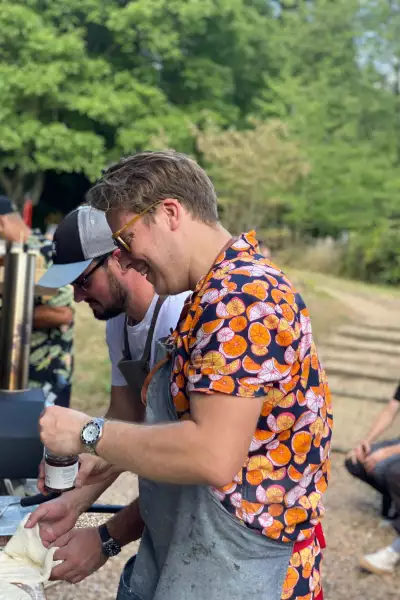
Mike and his best friend cooking pizzas for 40 at a first birthday party
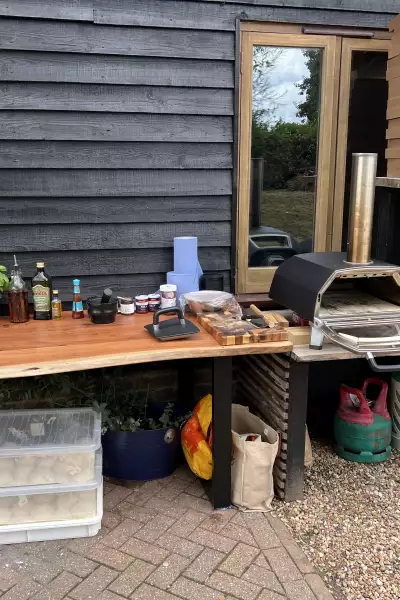
The cooking station for his goddaughter's party, consisting of two Ooni ovens
“It’s a simple thing, simple ingredients; you don’t want to over-complicate the pizza,” says Vincent, “but if you don’t know what you’re doing, you’ll get found out very quickly.” I can attest to that, of course, but it’s this game of risk and reward, and the fundamental nature of its cooking, that continues to draw people in.
I’m far from the scale of Dough Hands or Vincenzo’s in terms of my pizza-making experience, but I’ve probably cooked 250 pizzas at high heat in the six years since I first started. It’s just about enough that I can identify with them and with Tom Gozney, in knowing that cooking great pizza is simply different from cooking almost anything else.
From the social element to the deep natural draw of live fire to locking in and feeling a sense of control over something so potentially volatile, there’s a feeling deep in your bones that only cooking great pizza over fire can give.
“There’s a sort of ceremony and a romance to it that’s hard to ignore,” Thom Elliot agrees. “I don’t think anyone would have thought about pizza like that before.” Can the roots of the passion for pizza of someone in their garden, cooking 65% hydration dough in a wood-fired oven, be traced directly back to the spirit of Naples? Maybe. Or perhaps that spirit has been transposed through diners at London’s finest pizzerias, the passion and design chops of Tom Gozney and the team at Ooni, and the new-school riffs of people like Dough Hands and
Vincenzo’s, who took a DIY approach and honed it via the products that were newly available to them. Whatever you read, it’s by now clear to me that, amateur or professional, once that fire – literally – starts burning, it’s almost impossible to put out.