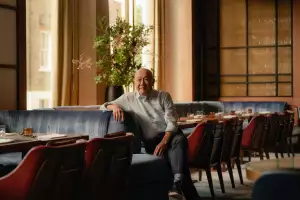
High-end omakase in London is becoming so commonplace that we rarely bat an eyelid, but one last year made us sit up and pay attention. Tobi Masa is the first London venture from chef Masayoshi “Masa” Takayama and, in fact, his first venture of any kind outside the US, where, for four decades, he has built a reputation as one of the most recognisable sushi chefs in the world.
It’s the kind of status that could lend itself to the sort of empire-building that saw his name outsourced to skyscrapers in the Middle East, resorts in Los Cabos, and pretty much anywhere around the world. 40 years on from his first restaurant, it’s only the second time he’s opened in a new city. It’s notable he chose London, and this is not a ceremonial, slap-a-famous-name-and-hope-people-come job – from the menu to the design, he’s hands-on.
Masa’s first restaurant was in Los Angeles. After an apprenticeship in Tokyo, he initially moved to play golf but discovered a fertile market in the city for traditional omakase – both Japanese expats who had moved amid increased business activity and Hollywood stars eager for event dining. Everyone from Marlon Brando to Madonna was a committed fan.
In 2004, he moved to New York, scooping up three Michelin stars in the process (although it became two back in November). Over 20 years later, he was ready to try a new city and opened Tobi Masa (sharing a name with the New York original) in the Chancery Rosewood.
We visited the new restaurant to chat to Masa about why he chose London, what he loves about the city, memorable Hollywood guests, and much more.
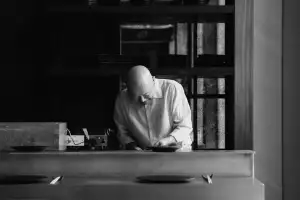
Chef Masa
Foodism: This is your first restaurant outside the US. What made you choose London?
Masa Takayama: I love London. There's personality here. I’ve had a lot of chances in other countries and cities, but it never felt right until now. I love so much about the city – the architecture is beautiful. I love its pubs. I could live here comfortably.
F: Was expanding to London always a long-term goal, or did the timing just feel right?
MT: I think it was a long-term goal. There were always opportunities coming through, and people kept saying to me, “Come to London, come to London”. We would visit, come back, and visit again. And so I think that just was sort of a sign – I just kept wanting to come back. London just had that feeling that the cream of the crop all came here.
F: How would you compare the dining scene in London and New York?
MT: London is more unique. The food quality and ingredients are much better here. There is better regulation. Take strawberries - London has the most amazing strawberries. In the US, the major produce comes from California, and the strawberries taste completely different. The meat here is also of incredible quality, mostly grass-fed, which makes a difference.
F: Tell me about your first foray into the US. You opened in the 1980s in LA – what made you want to open a restaurant there?
MT: It wasn’t on my radar. When I was working at a restaurant in Ginza, one of the customers who came often, almost every month, had a company in California. I finished my apprenticeship in 1987, and I decided I wanted to visit California - mainly to play golf. At that time, it was very hard to enter the US because you had to have a certain amount in your checking account, so he helped me with a company visa. While I was there, he took me to a sushi restaurant in Los Angeles, which was very busy, and it made me think, “Oh, the market is here”. So I decided to stay. I got my green card, and after about four years, I opened the restaurant. It was a tiny restaurant.
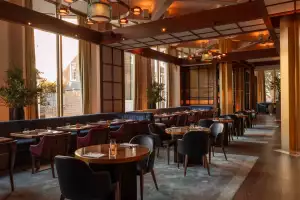
Tobi Masa at The Chancery Rosewood
F: It was one of the first omakase restaurants to take off in the US?
MT: Yes, exactly.
F: What was the early reaction like?
MT: That first restaurant was on Wilshire Boulevard; the counter had just 12 seats, and I did a menu for $250. Ruth Reichl (critic and food editor) wrote an article in the Los Angeles Times saying, “$250? Is he crazy? Who would pay for that?” But people did. At that time, many Japanese companies were expanding into the US, such as Mitsubishi and trading companies. So there was a bubble. Every single night, people from these Japanese companies would come.
F: And it became a bit of a Hollywood hotspot?
MT: Eventually, I moved the restaurant to Beverley Hills, but even before then, they had started to come, especially from the film and music industry. John Travolta was a regular. When he had his big comeback with Pulp Fiction, his meeting to sign on to the film was in my private dining room.
F: With Tarantino?
MT: With Tarantino. He (Travolta) visited me very often, and when he came this time, he suddenly moved to the private dining, and he said: “Masa, one of my friends is coming, please let me in my room”. I didn't know who it was. Then Tarantino arrived.
F: What was the level of awareness of Japanese food culture and omakase among those guests?
MT: It varied. For some, like Tarantino, he’d been to Japan many times and knew the cuisine. But for a lot of people, probably, that was their first introduction to that style of eating. But we had to adapt the menu – we included caviar, making it more luxurious. I had to work out how to incorporate these flavours Americans were used to into Japanese cuisine.
F: And then the move to New York in 2003 – what was the difference in dining culture between LA and New York?
MT: In California, my clients are mostly 80% in the movie industry. But in New York, it’s more from the financial industry. I didn’t quite know what the difference in palate was at first. So every day I would sit on this bench across from where the restaurant was getting built and try to figure out what kind of menu works here in New York. I also made a change to incorporate a bar. In Japan, we have izakaya – food and drink at the same time. So my thinking was to make a Western-style izakaya.
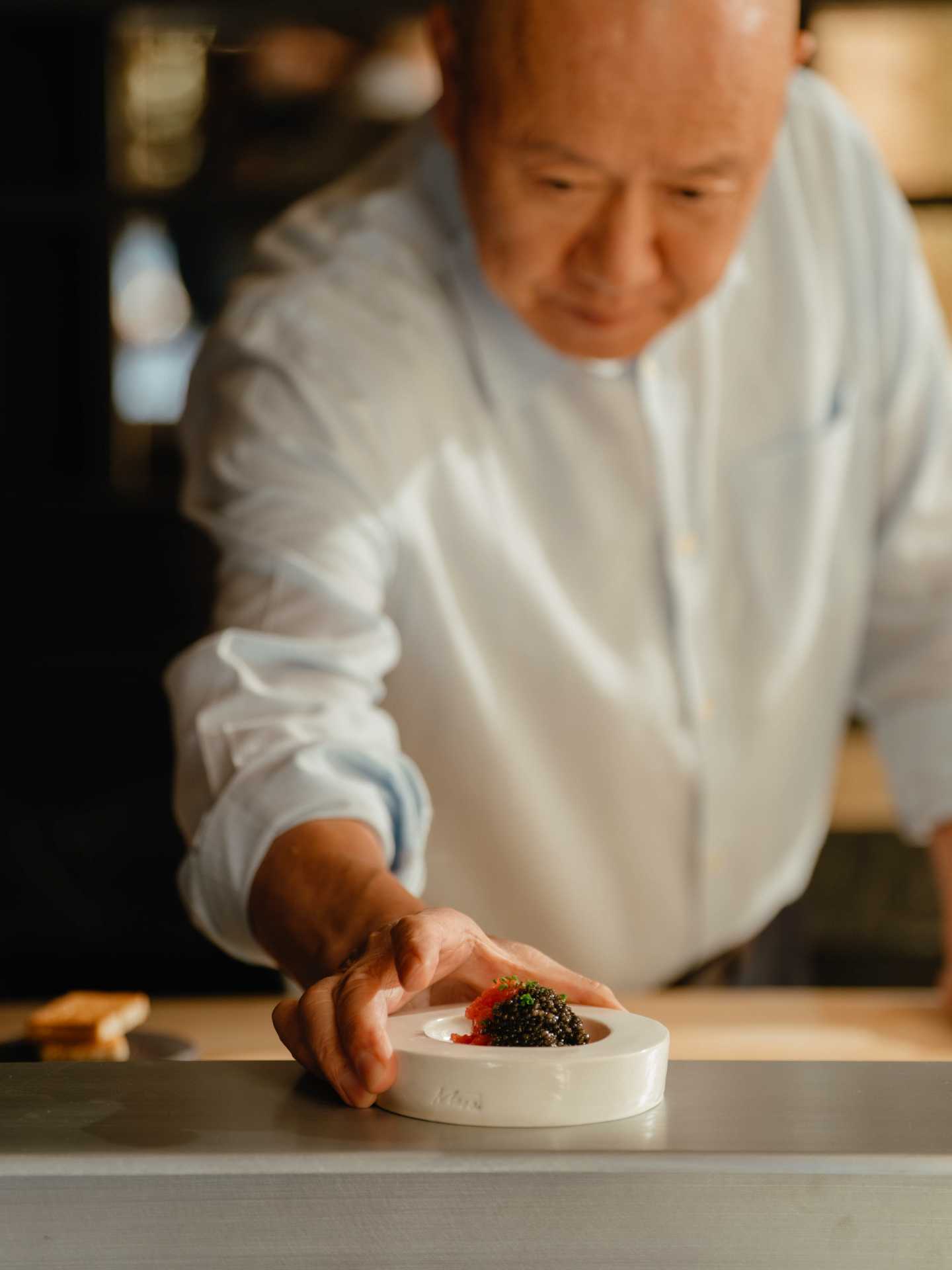
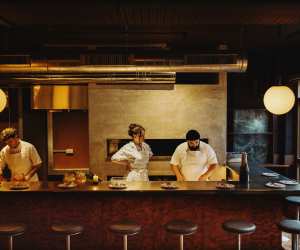
Plating up at Tobi Masa
F: I think a lot of dining culture in America is about the customer's choice, which is the exact opposite of omakase, which literally means "leave it up to the chef." Was there a culture clash in LA?
MT: Oh, there’s a big difference. We do try to accommodate, but within reason. But a lot of other similar places won’t budge – they’ll say no substitutions. Even with certain rules, a chef ultimately wants the customer to have a good time.
F: What about the local London customers – do they have a different taste from New York?
MT: In some ways, they’re the same. Like New York, people in London really love their food. They're foodie cities, and they’re international cities, so there’s a big appreciation for food from other cultures. I would say London has a deep appreciation for tradition, a quality it shares with Japan. They respect history and culture, even if they might be new to the style of food. In London, there are also far fewer dietary restrictions compared to New York. That makes sense to me. I think Americans are more, you know, particular. When it comes to omakase, I would say London's still a bit behind, but it's definitely catching up. There is less opportunity to import fish, so the menu is naturally more local – we utilise local clams, shrimp, crab. There’s great chicken, and great beef, although we do import wagyu.
F: What was your objective with Tobi Masa – was it trying to bring the New York style here, or an evolution of the style?
MT: It’s mostly the same concept as the New York restaurant, but adapting the ingredients and produce. Since the beginning, my philosophy hasn’t changed. As well as the food, the design of the restaurant will always be important – l design all the plateware and bring it over from Japan. It’s simple, mostly black. It’s been the same for years, but it’s all fashionable now that people are more drawn to the Danish-Scandi style.
F: What are some standout dishes in the new restaurant?
MT: We’ve got a local squid dish, sizzling and served with garlic and olive oil. We visited Brat while in London, and they have a similar dish with garlic, small clams and lime juice. The chef (Tomos Parry) introduced us to the vendor, and that’s a dish we’re doing here. One we wish we could do is ice fish, which is on right now in New York. It was an idea I had when visiting Spain, they do something similar with angulas, or baby eels. It’s similar, but icefish are better than angulas – much softer, they almost melt. But we don’t have it here yet.