"Are you pulling my leg?" said Duncan, the taxi driver shuttling me from Chelmsford Station to Danbury Ridge Wine Estate, when I told him about the purpose of my visit. I explained how Crouch Valley in Essex is being heralded as the future of English still wine and even as the United Kingdom's answer to Burgundy. Apart from cricket-bat production, Danbury, he said, was known to locals as nothing more than a through-village to the seaside or Maldon (yes, of the sea salt).
I wasn't totally surprised by Duncan's incredulity. I'd been to Chelmsford before, for a good friend's birthday, and I don't think he'd find it an unfair characterisation to say it would be hard to imagine the town exuding the rolling-hill charm of a European wine region. I'd also had a few bottles of Danbury Ridge before. I'd enjoyed them, but nothing had stopped me in my tracks or hinted at the thrilling future to come. That was about to change.
After a long discussion and a tour of the cellar, we tasted pinot noirs that could have easily been from Volnay and Gevrey, but it was a 2023 chardonnay from a single plot called 'Octagon Block' that felt like a eureka moment. It had an alluring perfume of oyster shell and orange oils, and on the palate, an eruption of electric acidity and bursting citrus, tempered by layers of slaty minerality and clotted cream. That a wine from Essex could be reminiscent of a Meursault Premier Cru is remarkable.
Don't believe me? Fair. But the evidence is stacking up in England's favour. This chardonnay was tasted blind at the London Wine Fair by 20 MWs and MSs, alongside 34 other iconic chardonnays, including a £700 bottle of Bâtard-Montrachet. It came third. "No one could possibly have guessed where it was from," says Danbury Ridge co-owner Janine Bunker.

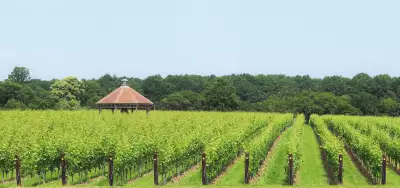
The Crouch Valley, adjacent to the River Crouch, is becoming the most highly rated English region for still wine
Aerial Essex
I told Duncan the result on the drive back to the station, and whilst the price of that bottle would have been an obstacle, he was intrigued to learn of a bottle of Tesco Finest English white for £12.50, not far off his usual Villa Maria.
It's not the only English chardonnay that's been fooling white burgundy lovers. At the Whitewolfe Estates in Kits Coty, Kent, the wines have "often been mistaken for some top burgundies in blind tasting by sommeliers," including comparisons to Saint-Aubin and Premier Cru Chablis, says co-founder of the estate, Claire Whitehead. But she's wary of leaning into the flattery. In fact, many winemakers push back on comparisons to French wine regions.
"We do not aspire to pretend to be Burgundy," she says. "If anything, we take more inspiration from New World regions such as Tasmania." What the North Downs chalk gives them, she argues, isn't something found there. "The stunning chalk North Downs of Kent are individual," she says, pointing to the energy and minerality running through the wines as proof of that site specificity, not imitation.
Many English winemakers are pushing back on comparisons to French wine regions
Confidence in this place-based quality is starting to show up in restaurants. Aulis, Golden Tooth, AngloThai, Cycene, Pine, and Fordwich Arms now offer all-English pairings or England-focused lists. "We're featuring more English wines because they're no longer a novelty," says Charles Carron Brown, sommelier at Aulis. "They're simply excellent."
Even so, Whitehead is cautious about how far the shift has actually travelled: "We're still in the era of it emerging. English sparkling wine now has a valid space on the global market, but people are still very wary of English still due to the huge variability of quality." It's telling, she says, that wine connoisseurs still arrive at tastings "expecting something thin, acidic and simple and are instantly surprised at the intensity, body and concentration of flavour in our premium wines."
That variability remains an issue. 31% of English wine production is now still, but it's been notably vintage-dependent (2018, 2022 and 2025 were especially strong years). Demand is now outpacing that reality, as British still wine sales rose 10% in 2024 alone and have grown 117% since 2018, even as overall UK wine consumption falls. That's part of why the calculus is shifting.
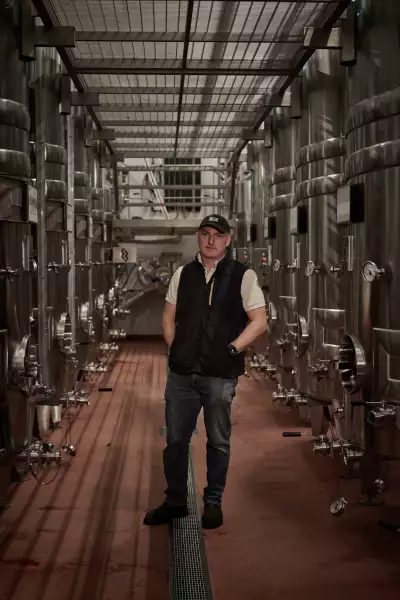
Danbury Ridge's winemaker Liam Idzikowski
Jeremy Rata
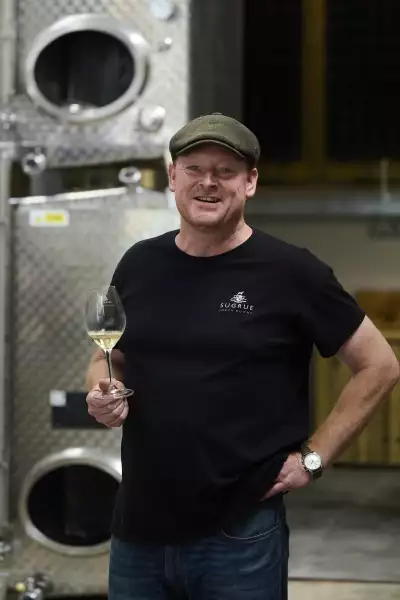
Iconic winemaker Dermot Sugrue worked at Nyetimber and Wiston before setting up his own ventures
Sarah Weal
"What we're now seeing is this kind of shift towards planting and managing for still, rather than it being a happy accident," Bunker says. Not everyone making that shift is doing it for the right reasons, though. Sparkling producers have arguably over-planted and now find themselves in a situation where the export tap to America and Asia never fully opened against Champagne's brand power, and cash-strapped estates have had to turn to still wine to stay afloat. As a result, Bunker says some have ended up over-yielding chardonnay to ensure money comes in on an annual basis. "That's the biggest danger," she suggests.
With no clear planting regulations and far less equipment required than for sparkling, the barrier to entry is low, and this cuts both ways. "There's probably going to be quite a lot of very bad English still wines produced over the next five to ten years, and then there'll be that consolidation," says Bunker.
It's a real tension, but Danbury Ridge is demonstrating the way to succeed. "We are learning every vintage, because there is no precedent for what we are here," head winemaker Idzikowski says. "We don't have a couple of hundred years of history to look back on and say, OK, what worked, what didn't work." Even the comparisons resist tidiness. "I don't think we're going for the 'Essex is the new Burgundy' line. It's an easy one, a catchy title... but it's different soils, different conditions. It's more clay-heavy here," Bunker says.
Even so, Burgundian winemakers are taking notice. Alex Moreau and Pierre Dujac (Domaine Dujac) are now collaborating directly with Idzikowski on Crouch Valley fruit. Idzikowski is nonetheless candid about the region's shortfalls. Essex still lacks the processing infrastructure of Kent and Sussex, and winemakers from these regions are swooping in. After tasting Danbury Ridge's 2021 vintage, Gusbourne's Charlie Holland went and bought vineyards in the valley, he explains.
Sussex producer Sugrue also rents vineyards in the valley, but its initial still wine emerged almost by accident. During the scorching 2022 heatwave, maverick winemaker Dermot Sugrue aged surplus chardonnay in American oak, without topping it up. Moving between wineries, it unexpectedly developed a layer of flor yeast. Rather than dumping the barrel, he blended the oxidative liquid with a fresh 2023 batch and released it as Bonkers Zombie Robot Alien Monsters From The Future Ate My Brain, producing a rich chardonnay that wine guru Jancis Robinson raved about.
"If someone told me 20 years ago I could make world-class red, white, and rosé still wines in England, I wouldn't have believed them," Sugrue reflects. Alongside Crouch Valley pinot noirs and Bonkers (version two is leaner and more Chablis-esque), he makes a barrel-aged rosé and a recently released red made mostly from pinot meunier, playfully named Never Mind the Gamay. Bright, juicy, and carrying Sugrue's trademark salinity, it proves England can craft concentrated reds beyond Crouch Valley. Sugrue is now shifting 25% of his total production to still.
In Kent, Ham Street Wines takes a different approach. "Lots of big producers like Gusbourne, Chapel Down and Westwell started reliably producing nice clean stills," says Jules Phillips, who runs Ham Street with his wife, Lucie Swiestowska, "but for us, seeing the range that Tillingham and then Dan and Nicola Ham produced around 2019–21 were real wake-up moments for still natural wines."
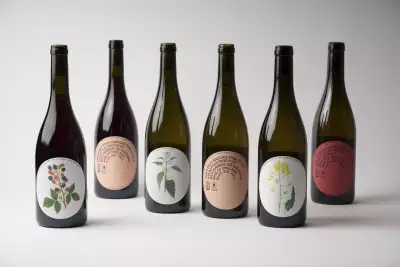
Natural wines from Ham Street in Kent
Working with low-intervention principles, their five-varietal field blend leans into vintage variation rather than fighting it. "Our terroir is very fruit-driven and expressive... quite soft, balanced, and fresh," Phillips says, though he's quick to admit the answer keeps moving: "Ask me next year, and my answer will probably be different." The philosophy, ultimately, is a rejection of imitation: "Let's claim English wine for its own, not just copy Champagne or Burgundy."
The energy isn't confined to the southeast. In the New Forest, just 90 minutes from London, Tim Phillips produces small amounts of wine under the label Charlie Herring, farming chardonnay, sauvignon blanc and riesling in a walled vineyard built in the late 19th century, entirely without sprays or sulphur. Wiltshire, too, has emerged as a surprising region to watch for natural wine, with a wave of experimental producers like Offbeat Wines and Ben Adams producing vibrant, original wines.
What's been happening down in Devon for decades is perhaps less expected. Sharpham Estate has been making wine in this sheltered valley for 45 years, since 1981, though its modern era wears the Sandridge Barton label. Bucking the UK's sparkling trend with a 70% still-wine focus, the estate leverages this frost-protected maritime microclimate and its rare volcanic-limestone soils to craft distinctive, textured still wines.
Sandridge Barton pioneers low-intervention and regenerative methods, including spontaneous fermentations and cover crops in the vineyard
"In the southwest, we get the weather coming off the Atlantic; we're influenced by the Gulf Stream, and we get a slightly longer, milder growing season," marketing and operations manager Tom Wedgery says as we look down at the vine rows running straight toward the River Dart estuary, the breeze carrying a faint, salty tang from the tidal water. "Think of it like slow cooking; you can get a bit more depth out of it if it's slow and low." The rebranded estate pioneers low-intervention and regenerative methods, with spontaneous fermentations, neutral oak micro-oxygenation, and clover cover crops in the vineyard. "We want our wines to express this vineyard and the conditions of that year," Wedgery adds.
In the spirit of attempting to discover what works for the region, Wedgery leans into an unlikely grape: madeleine angevine, a historic Loire variety. In the Dart Valley, it's reworked into muscadet-style whites with broad palates and natural salinity. "We think madeleine is so suited to our slightly cooler, longer growing season in the southwest," he says. A single-vineyard, barrel-aged version that underwent lees stirring and malolactic fermentation has depth of fruit and floral complexity. It's waxy and mineral, with notes of peach and lemon thyme. This spirit of trial extends to their experimental series, featuring releases like their oxidative, oak-aged Goat Oxy Bacchus, as well as skin-contact oranges and pet-nats. Beyond Devon, people are taking note. The Pig's Head in Clapham – UK's Best Sustainable Pub in 2024 – pours Sandridge Barton wines from kegs.
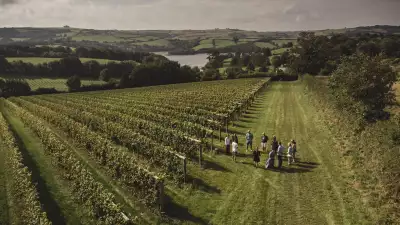
Vineyards at Sandridge Barton in the New Forest
But perhaps the biggest test lies beyond British borders. In Paris, where 95–98% of the wine poured is still French and most lists give foreign bottles a single token page, English wine barely registers yet. "It's all vin anglais to them," says Josh Dell, who runs Britpop, a platform staging tastings and dinner events to promote British wine in France. "I'd say we're still in the territory of maybe 60% of people who just don't know we make wine."
But Dell's approach isn't to argue England's case cold. Instead, he'll pair a Sussex or Kent still wine next to a French equivalent, a Chablis premier cru beside an English white, and let curiosity do the rest. "When we were offering people at [Poney Club] bar the choice, they were like, oh, I want to try it; I've never tried this before," he tells me over the phone. The clearest proof came with a Tillingham pinot gris, which shocked a table of Paris restaurateurs mid-meal. They were so struck, in Dell's words, by "the succinctness in its character" that they proposed a pop-up collab on the spot.
England's still wine still has a long way to go before it's a fixture on a Paris list rather than a novelty at one dinner, but that it's being drunk in Paris at all was inconceivable a few years ago. Still wine is, moreover, the platform where England is carving out its own identity and moving away from champagne adjacency.
Spending a couple of hours at Danbury Ridge, I could feel that the excitement and the meticulous attention were firmly rooted in Essex. Despite the Burgundian inspiration, the future will look different because of the specificities of Crouch Valley's geography. Because of its water.
As Idzikowski points out, "They don't have estuarine influence in Burgundy." It may be impossible to resist comparisons with Gallic wine ways, but that need not lead to mimicry. English still will continue to make headway by learning what makes it so distinctive. f