Amid all the doom and gloom surrounding the decline of veganism at the moment, one of the biggest stories was that of Eleven Madison Park. Last August, it announced that after over four years of operating without animal products, it would reintroduce meat to its menu. Restaurants close every day, but this was notable because it was arguably the world’s most prominent plant-based restaurant, with three Michelin stars. The fact that it wasn’t closing but merely abandoning its principle somehow felt even more acute. It comes at a period of time when veganism is still gaining publicity in both the UK and the US. However, it seems the obituaries section would be more suitable for its coverage than food and drink.
Personally, I’ve been slightly more sceptical about these death notices. Undoubtedly, there is a downturn, but what has always set veganism apart from other dining trends, like small plates or New York-style eateries, is that it has always been grounded in a moral stance – one that, when it comes to the environmental impact of meat consumption, is cast-iron.
For longevity’s sake, that’s a key point of difference. There are also continued success stories: Plates became the first ever plant-based restaurant in the UK to earn a Michelin star. Holy Carrot opened its second venue in Spitalfields earlier this year, while the Mildreds chain continues to thrive. What these eulogies may have failed to acknowledge is that something different is emerging from the ashes.
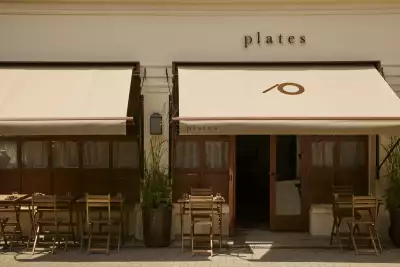
Plates is the UK's only Michelin-starred plant-based restaurant
Vegan capitalism
Viewed through one lens, the future does look bleak. Beyond Meat, arguably the most famous plant-based meat brand that had its record sales year in 2020, aggressively reduced operating expenses amid potential catastrophe. Neat Burger, the vegan fast-food chain backed by Lewis Hamilton and Leonardo DiCaprio – who can both risk a bad investment or two – entered voluntary liquidation after a series of closures. The list keeps on going – Meatless Farm, Meati, Believer Meats – all alternative meat companies that have become insolvent in the previous couple of years.
Meanwhile, get ten minutes’ worth of your daily brainrot on Instagram or TikTok, and you’ll probably see a bulging man in a tank top eating steak, hard-boiled eggs and cottage cheese off a wooden chopping board. Ultra-processed foods are the new number one enemy in the online fitness industry, and fake meat alternatives have become its poster child. Running alongside it, another trend – ‘proteinmaxxing’, which tells us to eat at least twice our body weight of the stuff every day.
If I’m doing 50% of my shopping under the assumption I’m being hoodwinked by a marketing executive anyway, I may as well get the sourdough with only five ingredients rather than the one with 20
Whether you’ve bought in completely and have already converted to the carnivore diet, or you think the UPF-warrior influencers are all funded by Big Milk, doesn’t really matter – it will have an effect. It also doesn’t matter that key proponents of the scientific benefit of meat-eating include Jordan Peterson and unhinged influencers like the recently incarcerated ‘Liver King’. If I’m doing 50% of my shopping under the assumption I’m being hoodwinked by a marketing executive anyway, I may as well get the sourdough with only five ingredients rather than the one with 20. And, yeah, now that you mention it, what exactly is in that processed ‘facon’ I’ve been putting in my body? The narrative might be stronger than the science, but for most, it’s enough.
So, what changed? A perfect confluence of the market becoming oversaturated just as demand and popular sentiment faded. One reason, it has also been argued, is simply that veganism was always going to hit a ceiling; like left-handedness, the upward curve was always going to flatten out. And yet, grasping this most basic tenet of economics was beyond many VCs and investors who continued to pump money into plant-based alternatives in the hope that the good times would continue to roll.
In the US, according to CNBC, plant-based meat sales hit over a billion in 2020, a 46% jump in a single year. Investors piled in accordingly, pouring nearly £2 billion into the sector in 2021 alone, before dropping off significantly in the next couple of years, and then cratering.
Perhaps more pressingly, there’s also a fundamental mismatch when a movement based on genuine concern for animals and the environment is paired with another that ultimately just wants to make money and is happy to cut corners in doing so. If people want vegan alternatives and you want to make money off them, cooking up some cheap chemical concoction in the shape of a cocktail sausage might seem like a good idea. But people want to cut their daily meat intake to see genuine, lasting change, not to line the pockets of future The Diary of a CEO podcast guests.
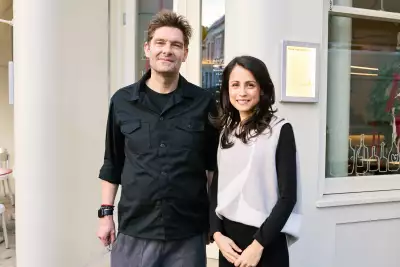
Daniel Watkins and head chef Maria Criscuolo of Holy Carrot
When I ask Daniel Watkins, the chef and co-founder of the plant-based London restaurant Holy Carrot, whether the vegan industry got too carried away with meat-based alternatives, his response is emphatic. “Massively. I was recently asked for an alternative to smoked pork, but that’s not really how I approach things. I’m not trying to recreate meat or imitate it – it needs to stand on its own. The focus is on making something satisfying in its own right, with great texture, smokiness, and depth of flavour, rather than trying to be ‘like chicken’ or ‘like pork’.”
Sarah Wasserman, director of food and brand at Mildreds, shares the same view: “I’m quite glad that we’re moving away from all of that. There was a time when I was being contacted by two or three companies four times a week about meat alternatives. And some of it was pretty grim, from big multinationals. And I think that has created that suspicion of where people are coming from.” If the chefs behind two of London’s most prominent plant-based restaurants are celebrating rather than mourning this loss, is it really that big a blow for the vegan industry, or a chance to reframe as something else?
I think back to when veganism was in the ascendency, and it strikes me that the period between 2015 and 2020 was its sweet spot. I went vegetarian in 2017, when I was 19, and The Economist declared 2019 the ‘year of the vegan’. At that time, the most prominent vegan chef-slash-influencers in the UK included Ella Woodward and the BOSH! guys. In Ireland, it was the perma-positive Happy Pear twin duo, whose relentless camera-facing optimism gave them the nickname ‘Hummus Jedward’. They were all completely, unapologetically millennial; less like the vegetarian hippies of the 1960s, but in the same genre as cereal cafes and skinny jeans. And despite being at the forefront of the vegan cooking movement, they were, crucially, not chefs by trade. These restaurants and cookbooks were not bad by any stretch – The Happy Pear was one of the few plant-based spots you could actually bring a sceptical Irish dad reared on meat and two veg without complaint – but the culinary innovation was not really based on flavour or technique. Mostly, it was trying to cheat: watermelons were being turned into hams, cauliflowers turned into steaks, the run-off juice from the bottom of a chickpea can (aquafaba) was being turned into chocolate mousse, and we were being told, with a straight face, that you couldn’t taste the difference.
Embracing meat substitutes is a good way to get people interested, but less useful in getting them to stay
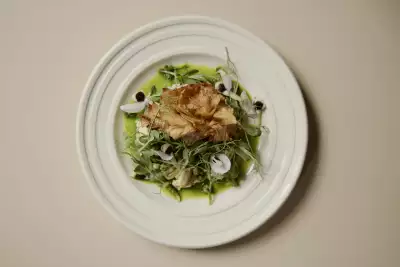
Embracing meat substitutes is a good way to get people interested, but less useful in getting them to stay. If you’re constantly focusing on what you’re missing, “you’ll inevitably be a little disappointed, which is kind of counterintuitive”, says Wasserman. On the tasting menu in Plates, there is no sign of watermelon ham, Impossible Burgers, or any kind of meat substitute. The food is about bringing out the potential in ingredients so they can stand on their own. That’s not to say that there is no place at all for meat alternatives. At Holy Carrot, Watkins uses “familiar terms like burger, patty, or schnitzel, simply because people need a reference point to understand what they’re ordering”. But now, he has found more success “putting vegetables at the forefront of the plate and rethinking what a balanced meal looks like”.
A recent Guardian article asked the question: ‘Is the UK’s love affair with vegetarian food over?’ It opened with a snapshot of the landscape, outlining how McDonald’s, Wagamama, Domino’s, and Pret have all scaled back their plant-based offerings. To me, it seems fast food menus of McDonald’s, Domino’s and Pret are unlikely to be battlegrounds on which the movement should be judged to have won.
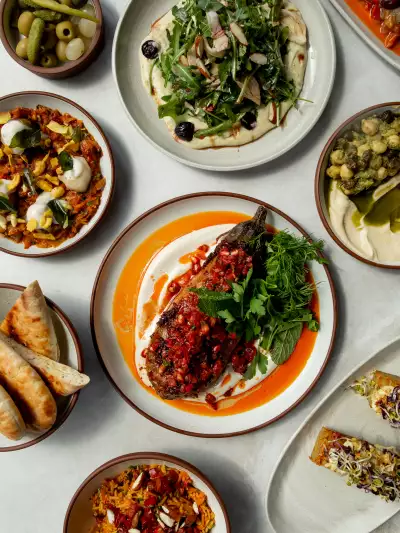
Market menu at Mallow
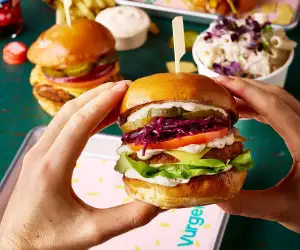
Major UK closures include vegan fast-food chain The Vurger Co and Clean Kitchen, which sported former BrewDog CEO James Watt as an investor. “I invested £150,000 into a business called Clean Kitchen. Unfortunately, the business did not quite make it, and I lost every single penny of my investment,” Watt wrote on LinkedIn. A trend of decline is emerging, but it’s hard not to look at the throughline of closures and bankruptcies and see that it’s the most hypercapitalistic version of veganism that is being diminished – a version that never really matched with the values of the movement anyway.
A trend of decline is emerging, but it’s hard not to look at the throughline of closures and bankruptcies and see that it’s the most hypercapitalistic version of veganism that is being diminished
To put forward an optimistic view, you could see a future in which the decline of the substitute-meat industry creates a gap that can be filled by chef-led, ingredient-focused vegan cooking, which is more likely to keep people interested for longer.
Culture wars: a new hope
Veganuary in 2026 didn’t capture the public’s attention in the same way as it used to – it didn’t become a lightning rod for public discourse, and Piers Morgan didn’t go viral for eating a vegan sausage roll on Good Morning Britain. And yet the underlying numbers remained strong – this year saw a record-breaking 30 million people take part, according to its report.
Henry Mance, UK news editor of the Financial Times and vegan author of How to Love Animals, wrote an article titled ‘Why the Vegans Lost’, in which he argued, along with increased scepticism surrounding UPFs and focus on protein, that a general lapse in idealism had something to do with its decline. “Even with all of the above, the retreat of veganism wouldn’t have been possible without another ingredient: the decline in idealism. Not long ago, liberals in particular were prepared to make sacrifices in the hope of a better society. Faced with overwhelming bleakness – Covid, Ukraine, high energy costs, Donald Trump’s re-election, Gaza – they have lost faith”. The fact that veganism started to take a significant nosedive after 2020 supports this, but it’s also hard to maintain idealism when your weekly shop is lining the pockets of investment angels and packed with ingredient lists that feature dozens more numbers than letters.
This political exhaustion is evident when I ask both Watkins and Wasserman what a healthy future looks like – they are both quick to distance themselves from the word ‘vegan’. “While I think veganism – and the term itself – is probably declining and can carry a certain amount of baggage, plant-based eating is definitely becoming more popular”, says Watkins. “The narrative for the Portobello restaurant has always been plant-based – it was never positioned as a ‘vegan’ restaurant per se, but rooted in a plant-based approach from the beginning.” There is some shorthand at play here: ‘veganism’, whether warranted or not, has always carried a certain militancy: tell someone you’re vegan, and they’ll be suspicious you’re going to try to turn them into one as well. “Plant-based” is more about the food. Sure, the goal may be the same, but achieved via a Trojan-horse method. These are simplistic terms, yes, but helpful when understood as a way to reframe a narrative that has been co-opted with negative connotations.
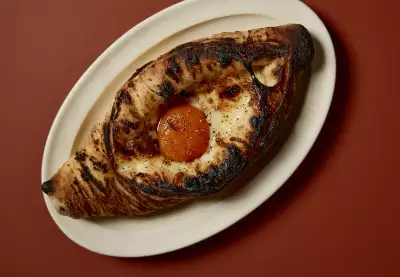
Khachapuri at Holy Carrot, which has introduced dairy to its new Spitalfields opening
For plant-based restaurants, the point about idealism poses an interesting question. On one hand, it feels unfair to ask a chef, whose main job should be to cook the most delicious food possible, to also be a spokesperson for a social movement. On the other hand, is it possible to be agnostic on the topic when a moral choice has been made? It’s a sign of the times that Watkins and Wasserman, as well as Kirk and Keeley Haworth at Plates, position their plant-based credentials as secondary to the food. Holy Carrot’s new Spitalfields restaurant also saw them reintroduce dairy to the menu – a small amount, featured in less than 30% of its menu, and carefully sourced. Like Eleven Madison Park, Watkins said this was aimed at “opening the door to new guests and making the experience more accessible”.
Similarly, for Wasserman, “the real cultural shift is not whether everyone becomes vegan or vegetarian, it’s whether people are more willing to try food that happens to be vegetarian or vegan. When I started, most restaurants would begrudgingly have one vegetarian dish. And now vegetarian food in those kinds of restaurants is so much more ambitious, so much more elevated.” What is undeniable is that the Overton window has shifted.
As a case study, I started eating meat again in 2024 after almost seven years without it. I can’t point to a single reason why – I just started craving it again. Undoubtedly, I was influenced by shifting conversations surrounding meat and diet. Unlike most new diet adoptees, I didn’t feel a change in energy levels or strength, just like I felt no difference when I went vegetarian in the first place.
The main benefit has been convenience – scrambling dinner together on a Monday after five-a-side is, admittedly, much easier now. But I’ve not reverted completely. I’ll happily eat vegetarian for long stretches of time, and am more conscientious about my meat and fish intake. People like me, who show up in statistics indicating a decline, actually represent growth compared to ten years prior. Veganism may not be in the zeitgeist, but it is intrinsically linked to an ethical argument that is not just going to go away. When it loops back around, the best way to win over light entertainers on a morning show may not be through a McPlant but a seasonal tasting menu with a wine pairing. The latter might just be the way vegan dining is going.