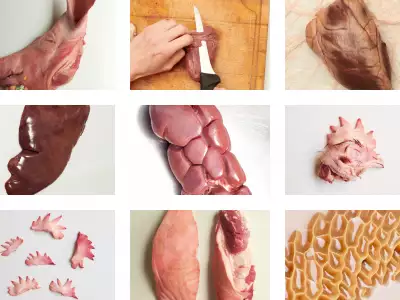
Offal made headlines recently, perhaps for the wrong reasons, when a lorry, to quote, ‘shed its load,’ on the M6 in Staffordshire in March. The spillage left a slurry of guts and organs splayed across the tarmac in a queue-to-the-horizon, 14-kilometre spectacle of viscera. I’ve been thinking about it ever since – specifically about how everyone I showed the video to winced or gagged. Gross! they exclaimed. Animal organs flattened into the grit of tarmac. If the headline had named the spillage meat rather than offal, would it have elicited the same reaction?
It’s not the first time I’ve heard offal described that way, and it got me thinking: what actually makes a food gross? Is it the smell? The texture? The appearance? Or is ‘gross’ just a synonym for foreign or unknown? When I cast my mind back to my own food meltdowns, the most vivid came in the south of France at 12 years old, where I encountered a sausage called andouillette. I remember wailing at the table, telling my mum I couldn’t eat this thing that was not like the chipolatas at home. Andouillette, for the uninitiated, is a French coarse-grained sausage made from pork intestines and stomach. It is no Richmond sausage.
Decades on, my relationship with offal has shifted considerably. Deep-fried brains with Café de Paris butter at Camille. Foie gras on toast with my family in Toulouse. Fish testicles in the markets of Kanazawa. Buttery sweetbreads on the shores of Lake Garda. The offal offering in London has never been richer and it’s by no means a new phenomenon – beyond St John, the unofficial patron saint of the genre, you can eat tongue tacos at Guacamoles in Peckham, braised chicken feet and sliced tripe across Chinatown, and liver skewers at Turkish mangals.
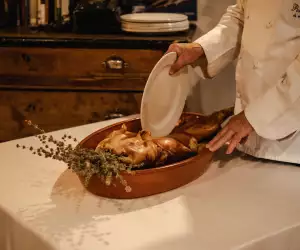
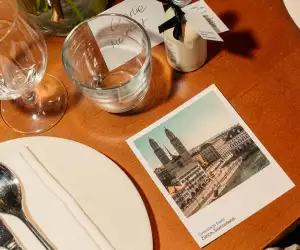
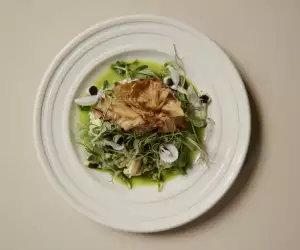
But my most recent offal encounter was different. It was a dinner at Sweetings, cooked by Madeleine Sanders and Sophie Hambling – two former St John chefs and the founders of Offcuts magazine. Canapés plus five courses: ox tongue with horseradish (a twist on the Sweetings classic eel and horseradish), cured ox heart with artichokes, rösti and a dusting of Whin Yeats wensleydale; spinach soup topped with foie gras; pig’s head with radicchio and persillade; pieds paquets with gnocchi laced with Espelette pepper; and a citrus-fragrant Sussex pond pudding rich with kidney suet. Unlike past offal feasts, this one never quite revealed itself as such. Wall-to-wall offal, and at no point were you asked to meet it halfway – it tasted like any other meat-centric dinner without overly challenging textures or ferrous flavours. From the days of the andouillette, I had come a long way.
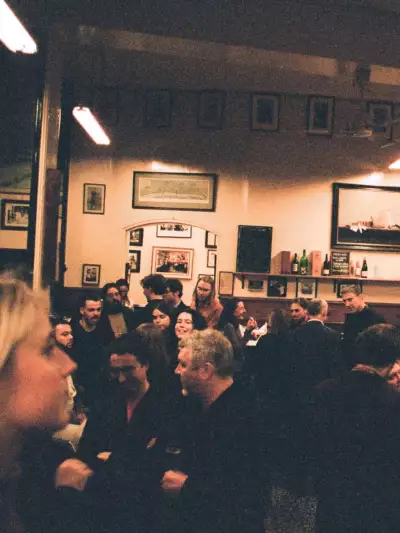
Offcuts dinner at Sweetings
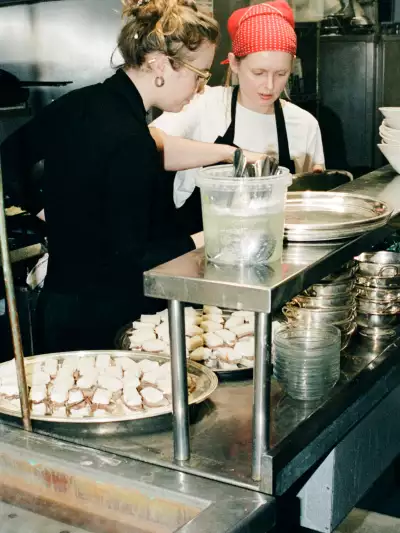
Madeleine Sanders and Sophie Hambling in the kitchen
Shahram Saadat
What Sanders and Hambling wanted to share wasn’t simply how good offal can taste in a restaurant, but why more of us should be cooking it at home. Offcuts dedicates each issue to a different part of the animal – head, tripe, heart, liver, kidney – breaking down, step by step, how to prepare and cook it in your own kitchen, with photos and recipes throughout. Which prompts the question: why, in a city where we’ll happily guzzle offal across a restaurant table, are so few of us slinging kidneys into the frying pan at home?
Vital organs
The case for eating offal from a nose-to-tail, zero-waste perspective is ironclad and widely reported, but its nutritional credentials are perhaps less trumpeted. Elliot Hashtroudi, head chef at Camille – an offal-focused French restaurant in Borough Market – came to offal’s restorative powers via the time-honoured route of a catastrophic teenage hangover. Growing up in a part-Iranian household, offal was simply part of the table. “There’s this Iranian soup made from tripe,” he says. “The second time I had it, I was a teenager and super hungover, and it completely cured me. There’s a belief in a lot of cultures that the food you eat corresponds to the part of the body it comes from – brains for the mind, liver for your own liver. Tripe is cow’s stomach, so I think it settled mine.”
Ana Da Costa, cook, recipe developer and founder of the Macanese supper club Fat Tea, echoes the sentiment. “I grew up around traditional Chinese medicine (TCM), where food is medicine. Certain ingredients are eaten for specific reasons: to nourish, to strengthen, to restore. Bone broths, tendons, organs – they’re all seen as deeply fortifying foods.” Her Instagram recipe videos on cooking offal like fish maw, head and chicken feet – filtered through the language of collagen, longevity and recovery – have introduced offal to a wider audience through entry points they already understand. But for Da Costa, it goes beyond nutrition. “Eating nose to tail, in a lot of cultures including my own, is about care, resourcefulness and respect for the animal. It’s what families – especially the matriarchs – have always done.”
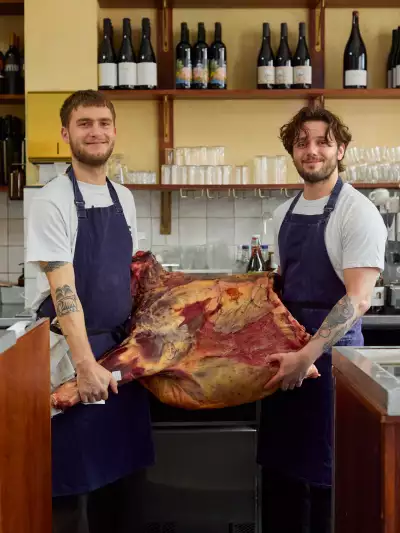
Chefs Tom Smedley and Nat Dwelly at Camille in Borough
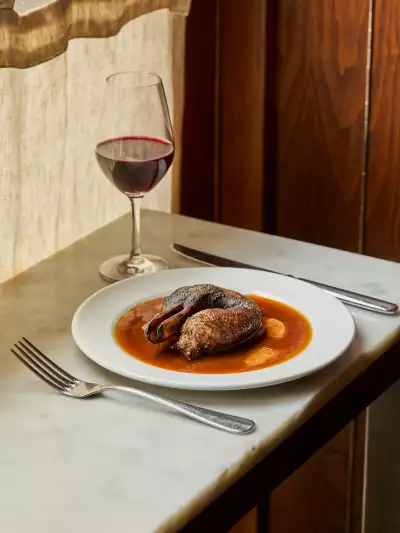
Duck Neck sausage
The numbers, when Sanders lays them out, are a revelation. Liver and heart contain roughly the same protein as prime cuts of beef and lamb, a quarter of the fat, three times the iron, at around half the price per kilo. “It’s a no-brainer,” she says. In a macro-obsessed world where people are popping pre-packed boiled eggs at standing desks like Tic Tacs, perhaps it is time to broaden the amino acid brief?
Squeam of consciousness
Consider how the sausage is made. A standard mass-produced chipolata – the kind I ate happily as a child – is minced pig shoulder, jowl and back fat, bulked with wheat rusk, pinked with cochineal or beetroot extract, and piped into a casing of reconstituted cow collagen. Andouillette, the sausage over which I shed human tears, is minced pig intestine and stomach in a casing of pig intestine. Both are, structurally, tubes of animal interior wrapped in animal interior. The difference between gleeful chipolata and weeping andouillette – the stronger flavour of the latter aside – is, mostly, who told you what.
Psychologists have a term for the gap. The ‘meat paradox’ – caring about animals while eating them – produces meat-related cognitive dissonance, which we manage through dissociation: separating the cut from the creature. A 2016 University of Oslo study found that a roast pork with the head intact prompted markedly more squeamishness than the same roast beheaded. We don’t recoil from meat so much as from being reminded what meat is. A chicken breast is the perfected end-state of dissociation – pale, geometric, shrink-wrapped; with every cue that links it to a bird removed. Offal does the opposite: a liver looks like a liver, a kidney like a kidney.
Chicken breast is the perfected end-state of dissociation – geometric and shrink-wrapped
In the UK, chicken dominates the dinner plate – breast alone accounts for 35% of all fresh chicken sales according to Kantar data. Offal volume sales have fallen 7.9% in the past year, with just 11% of households buying any at all. The wall is largely psychological, and the ironic thing is that offal builds it by doing exactly what it’s supposed to: closing the gap between a cut of meat and the living thing it came from. “It’s the food that reminds you the most where your food comes from,” says Gareth Storey, a tripe-loving chef and writer from Dublin, currently based in Lisbon, whose Substack often covers the joys of offal.
Much of it is vocabulary. The language around meat is engineered to manage the gap – “ox” not “cow,” “pork” not “pig,” “meat” not “muscle.” “Most people can eat chicken nuggets because they don’t look like meat,” says Sanders. “But as soon as it looks like an animal, that’s when people struggle.” Nick Gibson, owner of The Drapers Arms, which plays host each year to Glandstonbury (a multi-course offal feast cooked by a stellar line-up of chefs including Jacob Kenedy, Henry Harris, Ed McIlroy and more), has a story that suggests as much. A French regular attended this offal feast in April, enthusiastically, without registering the word’s meaning. After the first course, she approached Gibson. “The menu is very meat-heavy.” “Well,” he said, “it is all offal.” A quick Google Translate (offal to déchets) and the penny dropped. She continued and finished the dinner – but would she ever have come in the first place, had she known from the start?
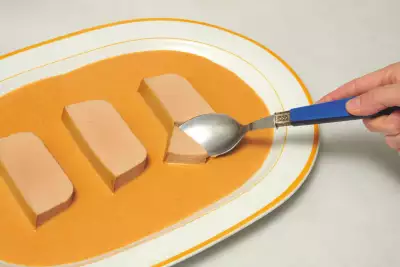
Warm chicken liver mousse and lobster bisque from the Offcuts Liver issue
The psychological theory shouldn’t discount the lived experience of genuinely bad offal. My own mother, born in the UK in the 1960s, point-blank refuses it – scarred by the tough, uric kidneys of her youth. Gibson’s formative memory is grimmer still: “At boarding prep school from the age of seven, we were regularly fed unspeakable liver and bacon. A grey, tough, stinking piece of dried-out leather. We were forced to stay at the table until it was eaten.” The common thread, says Hashtroudi, is preparation and freshness. “A very common mistake is to overcook offal, and it becomes rubbery, grey and just gross.”
Beyond bad memories lies generational rupture. “Pre-war, everyone ate offal at home,” says Hashtroudi. “Then came the microwave generation, then fast food. It just got lost.” Da Costa attributes part of this to the decline of the local butcher: “If you don’t grow up with it, there’s no reference point.” Not everywhere operated this way. Growing up in Macau, Da Costa never encountered offal as a category requiring courage – chicken feet, beef tendons and fish maw were simply meat. Hambling, who is currently working as an offal chef in a restaurant in Tokyo, has noticed the same. “Both younger and older customers go crazy for cuts I’ve never even seen before, including oesophagus.” Even in 7-Eleven, she’s spotted pig’s tongue and ear sold pre-chopped; in supermarkets, tongue comes pre-sliced and ready to grill – the preparation already done for you.
Tripe Advisor
There is a reason so many Londoners are perfectly happy to order offal at a restaurant table and rather less happy to confront it in a kitchen. A good restaurant is, among other things, a translation service – taking the cut you’d never bring yourself to buy and making it, through menu language, plating and trust, not only palatable but desirable, explains Hashtroudi. Tongue arrives sliced thin in a sandwich; sweetbreads come fried golden before you’ve registered they are a pancreas.
“It’s the same reason people order a chocolate soufflé when out – it’s something they don’t feel comfortable making at home,” adds Da Costa. Stripped of that institutional confidence, the whole project feels considerably more precarious. As Gibson puts it, cooking offal for guests can feel “a little risky” without knowing whether they’ll be willing fellow dinner guests.
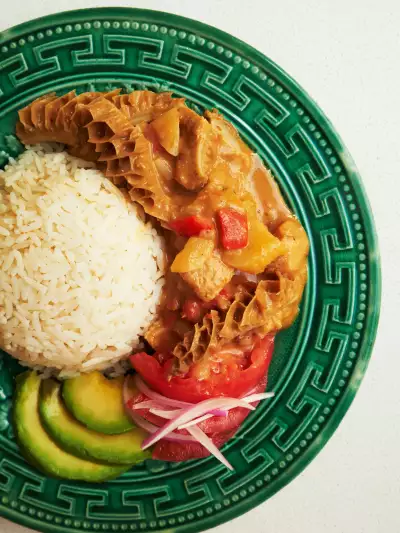
Guatitas is a tripe and peanut stew from Ecuador
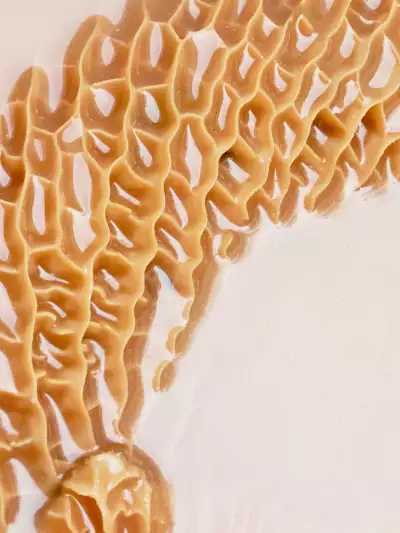
Tripe from Offcuts magazine
The sourcing problem compounds it. Beyond a few lonely chicken livers in an indifferent supermarket chiller, most offal requires forward planning – a proper butcher, probably pre-ordered. “There’s quite a lot of legislation and red tape around abattoirs in the UK about not selling certain parts of the animal that you’d easily be able to get hold of in France, for example,” explains Hashtroudi.
Then there is the gravitational pull of eating out as performance. Sanders is candid about it. “Eating out is so on trend and so part of being young at the moment,” she says. “It’s cool to go out in London, eat offal, take a photo of it.” Offcuts, she insists, is trying not to feed that particular beast – for all that it is beautifully designed and photographed, they are shooting accessible over cool, dinner over content.
House rules
So you’ve eaten chicken feet in Chinatown, you’ve got the St John tote bag, and you’ve eaten the crispy pig’s ear at the wine bar. Congratulations, you’ve made it to third base. The question is whether you’re prepared to bring it home?
Begin, as with most things in life, by making friends with your butcher. “It’s the best advice I can give,” says Da Costa. Specialist butchers will source what you ask for, given a few days’ notice. Halal butchers, Hambling points out, have most of it on display already, “and it’s impressive how many people who shop there just don’t bat an eyelid.” If you can’t get to either, Morrisons, of all places, has a well-stocked meat aisle – trotters, hearts, kidneys and livers among them.
For your first attempt, ease in with a gateway gut. Hashtroudi’s entry-point trio is chicken hearts, pan-fried with a quick reduction; tripe, given a long braise and a stew to melt into; and beef cheeks, which most people don’t even register as offal but which produce a hearty ragu. Storey also recommends starting with chicken liver: two onions sweated in butter, 250g of livers cooked for five minutes, the lot chopped together on a board, seasoned, finished with a knob of butter and parsley. Eat warm or cold on toast. Sanders’s chosen cut is ox tongue: buy it already brined, slow-cook in the oven and slice thinly. Gibson adds veal sweetbreads – pan-fried, simply, “and nothing there to frighten the horses.”
A mouthful of unrefreshed tripe will put a person off it for the rest of their life
The most common errors cooking offal at home are overcooking or poor preparation. “Chicken hearts are always overcooked,” laughs Hashtroudi. “People underestimate how little they need – and they really need to be cooked on a grill so they absorb the smoky flavour.” Sanders is firm on trimming the bile ducts from a liver before you so much as look at the pan, and on refreshing tripe properly – bring it to the boil, drain, start again – because “a single mouthful of unrefreshed tripe will put a person off for the rest of their life”.
Beyond that, it’s mostly courage. “Most offal cooking is actually very simple,” says Da Costa. “Clean it properly, cook it low and slow, and season it well. People often confuse ‘I haven’t done this before’ with ‘this is difficult.’” Her better advice, though: “Don’t start with the ingredient. Start with the experience. Make something undeniably delicious.”
Still unconvinced? Gibson prescribes literature. “Perhaps suggest they read Ulysses,” he offers. “The tender delight of Leopold Bloom with his greasy kidney in his pocket, and the description of its tangy frying, made me determined to enjoy kidneys as a matter of norm rather than great challenge.”